





Turkey has paved the way for Finland to join NATO but continues to hold up Sweden’s membership, presenting the prospect of the two Scandinavian countries now following separate paths to NATO accession.
“We have decided to initiate the ratification process in our parliament,” Turkish President Recep Tayyip Erdoğan said in a press conference in Istanbul on 17 March 2023, speaking alongside his Finnish counterpart, Sauli Niinistö.
Hungary, which had also help up Finland and Sweden joining the alliance, has followed Turkey in backing Finland’s membership but still holding off on Sweden. In a Facebook post on 17 March Máté Kocsis, parliamentary leader of the ruling Fidesz party, said that it would back Finland’s NATO membership in a ratification vote scheduled for Hungary’s parliament on 27 March.
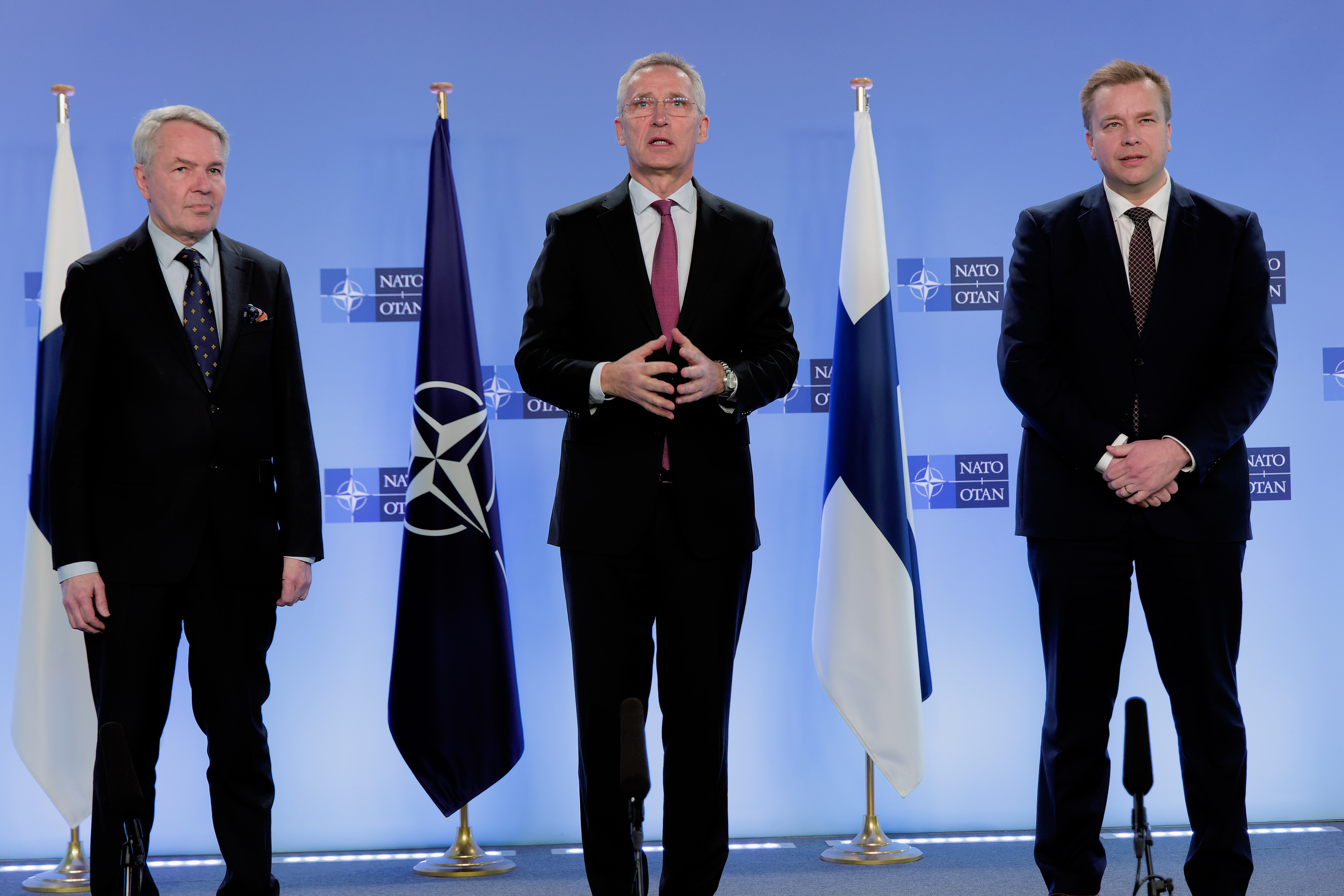
In the wake of Russia’s invasion of Ukraine in February 2022 Finland and Hungary simultaneously handed in official letters of application to join NATO on 18 May 2022. However, Turkey, supported by Hungary, has blocked Sweden and Finland from joining the alliance over allegations that both nations have sheltered Kurdish separatists that Turkey considers terrorists.
On the margins of the 2022 NATO Summit in Madrid a Trilateral Memorandum was established to focus on clearing the barriers to Turkey acceding to Finland and Sweden becoming NATO members. NATO Secretary General Jens Stoltenberg convened the third meeting under this Trilateral Memorandum on 9 March 2023.
Following Turkey’s 17 March announcement that it would approve Finland’s membership of NATO, Stoltenberg welcomed the move, saying that “considerable progress has been made in implementing the trilateral memorandum” during the previous week’s meeting” and that “rapid ratifications for Finland and Sweden are in everyone’s interest”.
The NATO secretary general added, however, that “The most important thing is that both Finland and Sweden become full members of NATO quickly, not whether they join at exactly the same time.”
Turkey has been a member of the NATO alliance since February 1952. Under the leadership of Erdoğan, however, who became president in August 2014, the country has sometimes found itself at odds with NATO and the West. In 2019, for example, Turkey was ejected from the US-led F-35 Joint Strike Fighter programme after ignoring US demands that it should compromise the F-35’s stealth technology by acquiring the Russian S-400 air defence system.
Peter Felstead
![[Photo:Brian Djurslev NATO SNMCNG1]](https://euro-sd.com/wp-content/uploads/2026/03/esd-news-218x150.jpg "The Subsurface Battlespace Just Got Clearer: SitaWare Maritime Launches PMI Planning Capability")
![[Photo ©Hanwha]](https://euro-sd.com/wp-content/uploads/2026/03/A-bird-eye-view-of-Hanwha-Booth-at-BEDEX-2026-Kopie-218x150.jpg "Hanwha to Showcase IAMD Capabilities at BEDEX 2026")
![Galvion’s flagship Batlskin Caiman® ballistic helmet system – NATO/NSPA [Galvion]](https://euro-sd.com/wp-content/uploads/2026/03/galvion-218x150.jpg "Galvion receives Batlskin Caiman order")
![[Credit Belgian Navy - jorn-urbain]](https://euro-sd.com/wp-content/uploads/2026/03/mmg-test-toolbox-pt-i-mil-Credit-Belgian-Navy-jorn-urbain-12_779x438-218x150.webp "Belgium Naval & Robotics delivers first MCM toolbox for the Belgian-Dutch rMCM programme")
![[Photo: INTRACOM DEFENSE (IDE)]](https://euro-sd.com/wp-content/uploads/2026/02/PHOTO-PR-Kopie-218x150.jpg "IDE demonstrates Advanced Hybrid Tactical Power Capabilities in major NATO Exercises")
![[Photo Bittium]](https://euro-sd.com/wp-content/uploads/2026/02/9046da31bbcb19c0_800x800ar-Kopie-218x150.jpg "Bittium and KNL Collaborate to Deliver Seamless Hybrid Communications for Defense")
![[Photo © Rheinmetall]](https://euro-sd.com/wp-content/uploads/2026/02/Seasnake-218x150.jpg "Breakthrough for Seasnake: Sweden becomes first NATO customer")
![[Photo: © improvee design / Adobe Stock]](https://euro-sd.com/wp-content/uploads/2026/02/Bild1-218x150.jpg "Sovereignty by design: Why software-defined defense is now critical for Europe")
![NATO ships from SNMCMG1 sail in the Baltic Sea in November 2025. NATO’s SNMG1 and SNMCMG1 task groups have been the at-sea ‘hub’ around which national and NATO responses to the Northern European CUI risk have been built. [Dr Lee Willett]](https://euro-sd.com/wp-content/uploads/2026/01/1-SNMCMG1-FW25-LW-Kopie-218x150.jpg "Northern European seabed operations underline the Alliance’s collective approach to CUI security")