



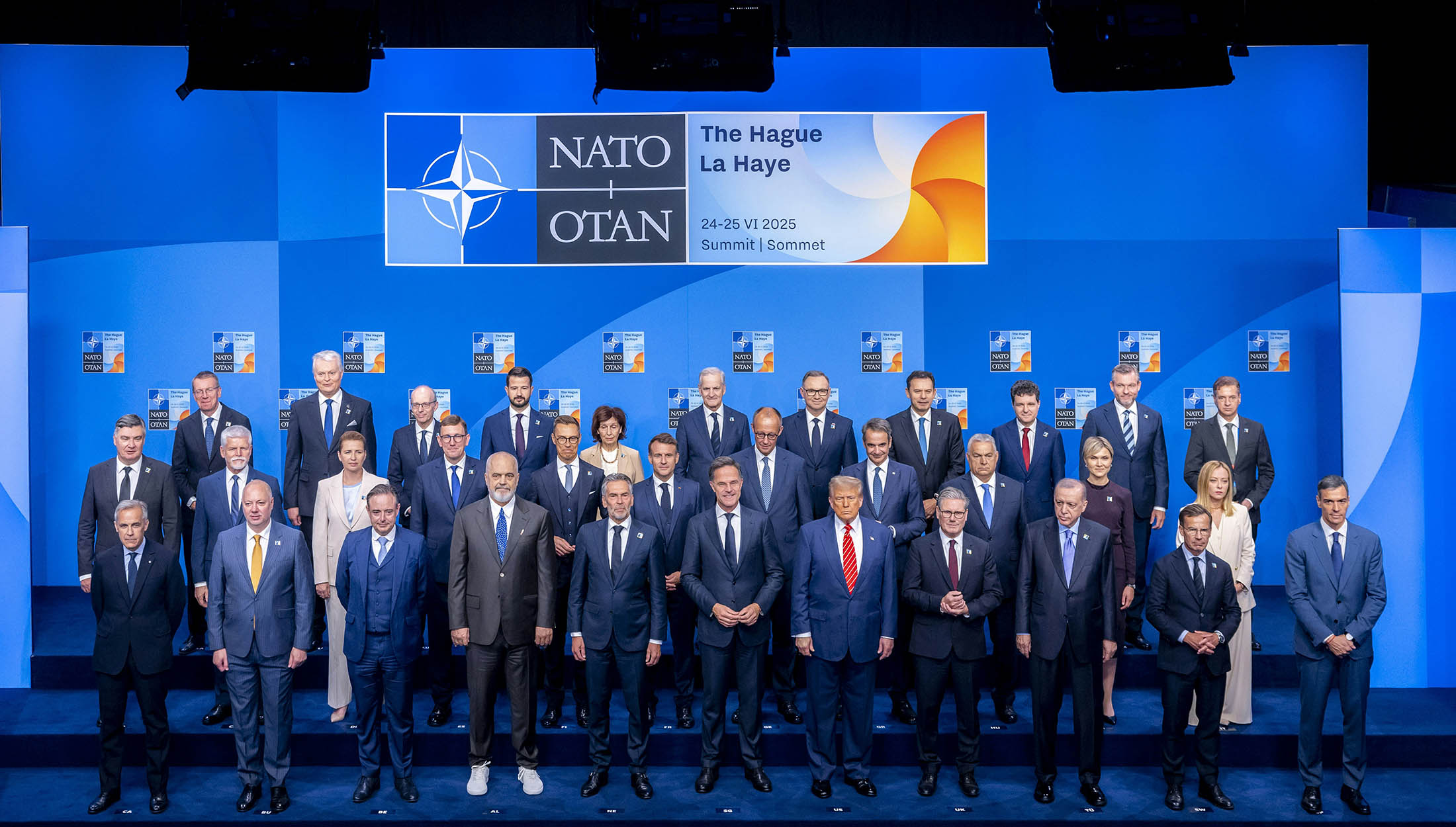

NATO concluded its two-day summit in The Hague on 25 June 2025 with the allies agreeing to invest 5% of their GDP on defence and reaffirming their continued support for Ukraine in its fight to repel the Russian invasion.
At the formal session of NATO Heads of State and Government on 24 June allied leaders adopted a summit declaration that set the new benchmark for defence investment, underlined the importance of ramping up defence-industrial production, and affirmed continued support for Ukraine. With The Hague Defence Investment Plan outlined in the statement, the allies committed to investing a total of 5% of GDP in defence – including 3.5% of GDP on core defence requirements and 1.5% on defence- and security-related investments like infrastructure and industry. This marks a major uplift from the previous benchmark of spending 2% of GDP on defence first agreed in 2006.
In 2025 all allies are expected to meet or exceed the pre-summit target of investing at least 2% of GDP in defence, compared to only three allies in 2014.
“Together, Allies have laid the foundations for a stronger, fairer, more lethal NATO,” Secretary General Mark Rutte stated in the summit’s closing press conference. “These decisions will have a profound impact on our ability to do what NATO was founded to do – deter and defend.”
Highlighting the challenges to allied security, Rutte stated, “Whether from Russia or terrorism, cyber attacks, sabotage or strategic competition – this alliance is and will remain ready, willing and able to defend every inch of allied territory,” explaining that the new pledge would “ensure that our one billion people can continue to live in freedom and security”.
The next NATO Summit is planned for 2026 in Türkiye.
![Soldiers from the Czech company, part of the EUFOR Multinational Battalion, conducted a series of joint training exercises in Mostar alongside operators from Bosnia’s State Investigation and Protection Agency (SIPA). [EUFOR BiH]](https://euro-sd.com/wp-content/uploads/2025/11/Handshake_EUFOR-BiH-218x150.jpg "2025 in the Western Balkans: A year-end SITREP")
![Initially deployed during Operation Granby, the United Kingdom’s contribution to Operation Desert Storm in 1991, the RAF’s air-launched anti-radiation missile proved to be a radar killer. The missile remained in service, and in the RAF’s inventories, until 2013. [Thomas Withington]](https://euro-sd.com/wp-content/uploads/2025/11/ALARM-Thomas-Withington-Kopie-218x150.jpg "Stratus symbol")
![: US Soldiers assigned to 3rd Battalion, 8th Cavalry Regiment, 3rd Armored Brigade Combat Team, 1st Cavalry Division, Task Force Iron, fire a M1A2 Abrams tank during a live-fire demonstration for Iron Defender 25 at Orzysz Training Area, Poland, on 17 September 2025. [US ARNG/Sgt Eric Allen]](https://euro-sd.com/wp-content/uploads/2025/11/Abrams-firing_US-ARNGSgt-Eric-Allen-Kopie-218x150.jpg "Baltic Security: SITREP")

![The US Navy (USN) carrier USS John C Stennis (left), the French Navy carrier FS Charles de Gaulle, and elements of their strike groups are pictured sailing together in US Fifth Fleet’s area of operations. The US, French, and UK navies are all developing ‘hybrid’ crewed/uncrewed mixes for their carrier airwing capability. [US Navy]](https://euro-sd.com/wp-content/uploads/2025/09/2-HST-CdG-USN-Kopie-218x150.jpg "Hybrid navies: Integrating uncrewed capability into carrier strike")
![The UK aircraft carrier HMS Prince of Wales (foreground) sails alongside the US carrier USS George Washington during Australia’s ‘Talisman Sabre’ exercise in July 2025. The two carrier strike groups (CSGs), plus Australian Navy assets, conducted CSG integration activities. [Crown copyright 2025]](https://euro-sd.com/wp-content/uploads/2025/09/1-PWLS-GW-TSabre-CC-UK-MoD-25-Kopie-218x150.jpg "Strategic shift: UK CSG deployment demonstrates switch in UK strategic focus")