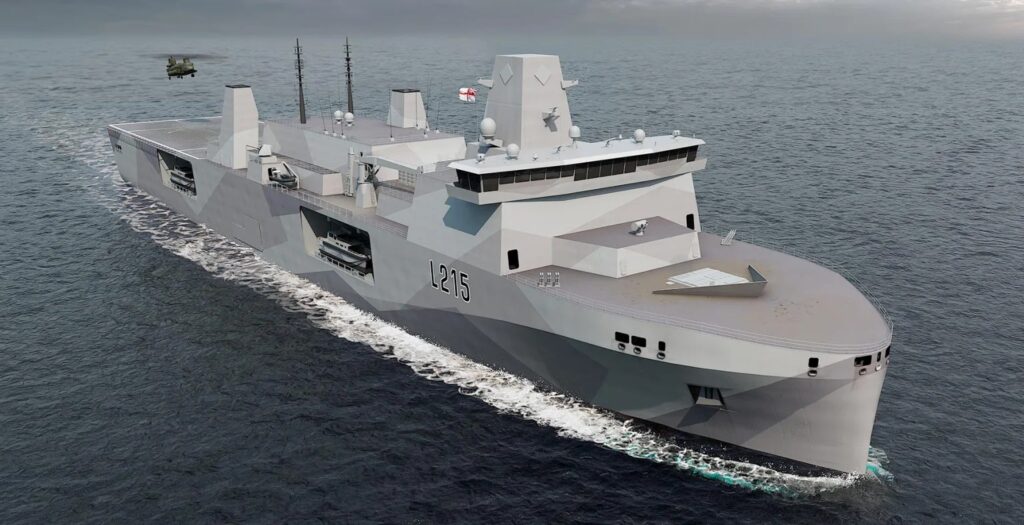





UK naval design house BMT unveiled on 26 August 2025 its Ellida Strike concept, which is focused on a future UK Royal Navy (RN’s) amphibious fleet recapitalisation that aims to replace ageing ships with a new generation of versatile and adaptable vessels.
The design draws on certain aspects of the RN’s evolving Multi-Role Strike Ship (MRSS) requirement, but has more generally been created to explore numerous facets of next-generation littoral strike vessel design. The Ellida Strike concept demonstrates how modern design principles can address complex operational requirements across missions ranging from delivering humanitarian aid to conducting high-end warfighting. Reflecting on lessons from recent defence reviews and the RN’s detailed MRSS requirements, Ellida Strike emphasises scalable capability, modularity and the integration of advanced technologies such as uncrewed systems and flexible well dock operations.
The vessel, BMT states, has been designed with careful consideration of rapid personnel flow and human factors efficiency: an approach that BMT says “resonates with the navy’s ambition for platforms that support dispersed, forward-deployed commando forces, robust crisis response and seamless adaptation to emerging threats and operational contexts.
“Ellida Strike is designed from the keel up to reflect uncompromising naval standards and optimal operational flow,” BMT stated. “While not a direct answer to the anticipated MRSS specification, it showcases design elements that are relevant and demonstrates the full range of capabilities that would protect the vessel in demanding conditions and support a wide range of missions. The concept prioritises efficient construction and real-world operability, offering a credible vision of what a future amphibious platform could look like.”
The Ellida Strike concept is designed around modularity, enabling rapid reconfiguration for mission-specific roles such as medical support, command and control, logistics or combat readiness through containerised pods. Its strike capability integrates long-range precision missile systems, enhancing fleet lethality and operational reach. The ship supports combined air manoeuvre operations and is capable of launching and recovering both crewed and uncrewed rotary-wing platforms, while a welldeck facilitates the launch and recovery of landing craft and autonomous vessels.
At its core Ellida Strike features a robust digital backbone that enhances connectivity and supports advanced command-and-control systems, BMT noted, adding that the design also prioritises human-centric principles, with ergonomic layouts that improve onboard living and working conditions, ultimately boosting crew well-being and mission performance.
“Every line of this ship has been drawn with purpose,” Andy Kimber, BMT’s chief naval architect, was quoted as saying in a company press release. “From propulsion to topside arrangement, Ellida Strike is engineered to deliver mission success in any theatre.”
“Whilst Ellida Strike is not the final answer, it’s a strong foundation for further development”, said Tim Neild, head of business development for the UK and Europe at BMT. “It invites discussion, collaboration and refinement. As the Royal Navy continues to shape its requirements, we stand ready to adapt and evolve our design to meet the needs of tomorrow’s operations. This concept represents a capability-led approach to design, showcasing what’s possible and demonstrating that BMT has both the expertise and the openness to partner as requirements mature.”
BMT will debut its Ellida Strike concept at the upcoming DSEI 2025 defence exhibition, held in London from 9 to 12 September.