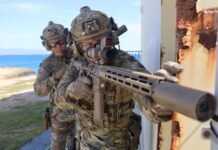



![The L7A2 General Purpose Machine Gun (GPMG) in action during a counter-ambush in Afghanistan by British troops. The L7A2 is the British version of the FN MAG, arguably the most successful Western GPMG. [Crown Copyright]](https://euro-sd.com/wp-content/uploads/2025/09/Afghan-GPMG-Kopie.jpg "Soldier from 1 Royal Irish Regiment Engages Taliban Following an Ambush")
David Saw

The machine gun first became a practical proposition in the mid-1880s, before going on to transform modern warfare. One of the issues that needs to be addressed when evaluating the machine gun sector is the classification of different machine gun types. In the beginning it was very simple – there was just the machine gun, then along came the Light Machine Gun (LMG), both of which used standard rifle calibre ammunition. Then at the start of the 1920s came the arrival of the Heavy Machine Gun (HMG), with the John Moses Browning designed M1921 in 12.7 × 99 mm (.50 BMG) calibre, which eventually evolved into the M2HB in use today.
That might sound rather straightforward in terms of classifications, but unfortunately it is not. In Germany in the 1930s the MG34 in 7.92 × 57 mm Mauser used the standard rifle cartridge, but this was something very different since it was the first of what was later described as the universal machine gun. With its bipod it could be used as a light machine gun, or in a sustained fire role it could be mounted on the Lafette tripod.
The MG34 was succeeded by the MG42 as the standard universal machine gun. The MG42 later formed the basis for the MG3, chambered in 7.62 × 51 mm NATO, which was adopted by the Bundeswehr in the late 1950s. Beginning in 2015, the MG3 began to be replaced by the Heckler & Koch (HK) MG5, also in 7.62×51 mm. It should be noted that the MG42 was incredibly influential in post-1945 machine gun design internationally and also the MG3 still remains in widespread service globally. it is also worth noting that another classification is used for the universal machine gun – the General Purpose Machine Gun (GPMG).
To round off the subject of machine gun classifications, a more recent evolution appeared as a result of the 5.56 × 45 mm NATO round becoming a standard infantry cartridge. Since more firepower was needed at the squad level, this led to the development of the Squad Automatic Weapon (SAW), essentially a lighter LMG in 5.56 × 45 mm. Finally, to conclude, we have the emergence of another machine gun classification in the form of the Medium Machine Gun (MMG), which is effectively a GPMG/universal machine gun type weapon in a sustained fire role. However, looking to the future, the GPMG/MMG is likely to find itself with expanded performance parameters, fulfilling HMG-type roles in a much lighter package and more manageable format.
When it comes to machine guns, it all began with the Maxim gun, developed by Hiram Maxim in the 1880By the 1890s, Maxim’s company and the rights to his machine gun had been purchased by Vickers, one of the most important defence manufacturers of the era. Vickers would go on to develop an evolved version of the Maxim design, known as the Vickers Gun in 7.7 × 56 mmR (.303), which would be adopted by the British Army in 1912 and remain in service until 1968. The Vickers was incredibly reliable. As long as you had ample supplies of belted ammunition, water for cooling the gun and spare barrels – changed every 10,000 rounds – the Vickers could fire more than 100,000 rounds in a day without issue.
![A US Army Maxim machine gun team during manoeuvres in Texas, in 1911. [Library of Congress]](https://euro-sd.com/wp-content/uploads/2025/09/Maxim-MG-in-1911_Library-of-Congress-Kopie-1024x640.jpg)
The M1910/30 not only outlasted Imperial Russia, it went on to outlast the Soviet Union and one might have expected that these weapons would fade into obscurity – not so! As war broke out in the Donbas, eastern Ukraine in 2014, Russian surrogate separatists raided weapon storage sites and fielded M1910/30 machine guns. To make up for their own equipment deficiencies, Ukrainian forces also deployed these old guns. Following the full-scale Russian invasion in February 2022, substantial numbers of M1910/30 guns were withdrawn from storage and fielded by the Ukrainian military.
The fact that a weapon that has a design basis in the 1880s and ceased production in 1945 is still in service in a combat zone is extraordinary! These days, the M1910/30 would be classified as an MMG and its ability to provide highly-reliable sustained fire is tremendously useful in repelling Russian assaults on Ukrainian fixed positions. Of course some might point to the fact that such a ‘mature’ system remaining in service and performing successfully indicates a lack of innovation in the machine gun sector. This would be an unfair analysis – the fact that a weapon with such a heritage is still in combat service and still performing illustrates the excellence of Hiram Maxim’s original design.
The 1980s saw the start of the Squad Automatic Weapon (SAW) era in terms of infantry weapons and the weapon that epitomised this was the FN Minimi (in 5.56 × 45 mm). The Minimi was adopted by Belgium, the US and 20 other NATO countries, as well as achieving a broader global customer base. Over the years the weapon has evolved, with different configurations fielded. Demands for extended range and more hitting power from a SAW class weapon saw FN further develop the weapon with a version in 7.62 × 51 mm. The current version of the Minimi, the Minimi MK3 is available in both 5.56 × 45 mm and 7.62 × 51 mm.
![n 82nd Airborne Division squad moves forward with the M249 Squad Automatic Weapon (SAW) during Exercise Swift Response 25 in Bardufoss, northern Norway, on 12 May 2025. The M249 is the US version of the FN Minimi, in service with 22 NATO countries. [US Army]](https://euro-sd.com/wp-content/uploads/2025/09/M249-Norway-Kopie-1024x682.jpg)
The NGSW programme consists of two primary elements – the Next Generation Squad Weapon-Rifle (NGSW-R) programme to replace the M4 carbine and the Next Generation Squad Weapon-Automatic Rifle (NGSW-AR), a replacement programme for the M249 SAW. These weapons will be fielded in the new 6.8 × 51 mm Common Cartridge. SIG Sauer won the contract to supply the new weapons, the XM7 for NGSW-R and the XM250 for NGSW-AR, as well as the new round in 2022. The weapons will also be fitted with a SIG Sauer SLX suppressor and a Vortex optic/fire control system.
If the US Army adopts new generation weapons and a new round, that will obviously challenge the conventional wisdom as regards future small arms in NATO. The XM7 and the XM250 were sent for trials with US Army and National Guard formations, with the industrial infrastructure to support the new weapons and the associated ammunition family being established. It seemed that the XM7/XM250 trials programme was going well and the US Army seemed totally committed to the new weapons and envisaged substantial purchases in the coming years.
![The XM250 was selected as the Next Generation Squad Weapon-Automatic Rifle (NGSW-AR), a replacement programme for the M249 Squad Automatic Weapon (SAW), seen here on display at Lake City Ammunition Plant to mark the start of work on a new 6.8 × 51 mm ammunition production line. [US Army Reserve]](https://euro-sd.com/wp-content/uploads/2025/09/XM250-Kopie-1024x683.jpg)
The Trent monograph added to the rumours of problems surrounding the new weapons, even calling into to question the absolute utility of the NGSW solution and the new ammunition. Both the US Army and the manufacturer, SIG Sauer, have disagreed with the assertions on weapon performance in Trent’s monograph. The official version is that the test programme for the new weapons and ammunition is progressing well and no major problems have been encountered. Even so, the negative comments from the user community about the NGSW are not going away and this might yet prove difficult and potentially derail the programme.
Ongoing doubts about the NGSW could pose future challenges for M249 users, particularly those operating early Minimi models now approaching the end of their service life. One obvious solution, adopted by Minimi users of older system variants, is to acquire the current MK3 version of the Minimi in either 5.56 × 45 mm or 7.62 × 51 mm. Elsewhere in Europe, Germany procured a domestic system in this category in the shape of the HK MG4 in 5.56 × 45 mm. IWI in Israel has gained success with its Negev SAW in 5.56 × 45 mm. This is available in a standard version, plus two versions with shorter barrels for special forces applications. The more recent Negev NG-7 is a 7.62 × 51 mm variant and, like the original Negev, is available in three different variants.
Looking at the SAW category in a broader international context, it is plain how influential the Minimi has been. Developments in China are a case in point. As a part of an ambitious new generation small arms programme, China has fielded the QJB-201 SAW in the Chinese 5.8 × 42 mm calibre, and the QJS-161 variant featuring a shorter barrel and reduced weight for special forces.
In recent years, there has been growing concern over the weight burden carried by the individual soldier. One means of lightening the load is to reduce the weight of an individual weapon, while not compromising performance. This challenge led FN to develop the Evolys, which they describe as an ultralight machine gun, available in both 5.56 × 45 mm (with a maximum range of 800 m), and 7.62 × 51 mm, (with a maximum range of 1,000 m). According to FN, the Evolys 5.56 weighs in at 5.5 kg, in comparison the Minimi MK3 in 5.56 mm weighing 8 kg. The Evolys 7.62 weighs 6.3 kg, whereas the Minimi MK3 in 7.62 weighs 8.8 kg. Evolys has been acquired by French Special Forces and is being evaluated by numerous other countries.
In terms of small arms, the Russian military has not found it easy to move beyond legacy Soviet systems. In many cases, this is no real hardship as these legacy systems, including machine guns, are high-quality. A case in point is the PK machine gun family, developed in the 1950s by a team led by Mikhail Kalashnikov. It was intended to replace the Soviet Army’s ageing World War II-era machine guns with a versatile GPMG, inspired by the German MG34 and MG42 systems. Although the Soviet Army had standardised on the 7.62 × 39 mm intermediate round, it was decided that the PK would use the old 7.62 × 54 mmR round, due to its superior range and power.
![A Ukrainian soldier with a PKM/PKP General Purpose Machine Gun (GPMG). Originally developed in the 1950s by a team led by Mikhail Kalashnikov, the original PK in 7.62 × 54 mmR has continued to evolve and is a high-quality machine gun solution. [Ukraine Ground Forces]](https://euro-sd.com/wp-content/uploads/2025/09/Ukraine-PKMPKP-Kopie-1024x683.jpg)
The Russian Ministry of Internal Affairs (MVD) reportedly had a requirement for an SAW in 5.45 × 39 mm, which saw the development of the Kord Tokar 2. Separately, the Kalashnikov Concern had developed their own SAW in 5.45 × 39 mm as the RPL-20, again geared towards the Ministry of Internal Affairs (MVD) requirement and also for the national guard, Rosgvardiya. Kalashnikov Concern has reportedly suggested that the Russian Army might be interested in the RPL-20 to supplement the PKM/PKP at the squad level. For the present, the Russian Army appears to prefer the longer-range and higher power of the PKM/PKP as its SAW.
In an ideal world, the future machine gun would offer more range and power than current systems, but without the penalty of increased weight from the weapon and its ammunition load. A move in this direction comes from SIG Sauer with their MG338 system that uses the 8.6 × 63 mm (.338) Norma Magnum round to achieve impressive results. Elsewhere, Ohio Ordnance has developed their REAPR-338 weapon, again using the Norma Magnum round, in response to a US Special Forces requirement known as LMG-M. This requires a weapon with a weight profile similar to the M240 GPMG, but capable of delivering greater range and enhanced on-target effects using a cartridge such as the Norma Magnum
Perhaps the successful fielding of a new weapon and round to meet the LMG-M requirement could change the state of play in the machine gun sector; perhaps it will be the XM250 and the 6.8 × 51 mm round that will be the catalyst for change? Or perhaps the majority of users will prefer to remain with the proven performance and reliability of weapons such as the FN MAG (known as the M240 in its US incarnation) or the PKM/PKP to meet their machine gun needs.
![The Ohio Ordnance REAPR-338 uses the 8.6 × 63 mm (.338) Norma Magnum round to achieve extended ranges and increased on-target effects. US Special Forces are looking into acquiring weapons in this category. [Ohio Ordnance]](https://euro-sd.com/wp-content/uploads/2025/09/REAPR1-Kopie-1024x771.jpg)
David Saw

![An M1 Abrams of the Royal Saudi Land Forces, during Exercise Eager Lion in Jordan, on 11 September 2022. While many Middle Eastern states have and continue to be dependent on foreign suppliers for their defence equipment, over the past decade, efforts have been made to change this. [US Army/Sgt Nicolas Ramshaw]](https://euro-sd.com/wp-content/uploads/2026/01/Saudi-M1-Abrams_US-ArmySgt-Nicolas-Ramshaw-Kopie-218x150.jpg "Tracing the path of Middle Eastern efforts to develop indigenous defence industries")
![David Saw [Foto: Mittler Report Verlag / picture alliance / Socrates Tassos]](https://euro-sd.com/wp-content/uploads/2026/01/D-Saw-4-Kopie-218x150.jpg "The Future Starts Now!")
![Acquired as part of the Next Generation Squad Weapons (NGSW) programme, the new US Army M7 rifle and the 6.8 × 51 mm Common Cartridge, shown here paired with the Vortex Optics XM157 SA-FCS mounted on the weapon’s Picatinny rail. [US Army]](https://euro-sd.com/wp-content/uploads/2025/11/M7-Rifle-Kopie-218x150.jpg "A luxury or a necessity? Fire control systems for small arms")
![The ubiquitous 9 × 19 mm Luger round, today commonly referred to as 9 mm Parabellum, was the round of choice for the first SMGs, and continues to be widely used today. [USMC/Cpl Jonathan Beauchamp]](https://euro-sd.com/wp-content/uploads/2025/11/9mm-closeup_USMCCpl-Jonathan-Beauchamp-Kopie-218x150.jpg "Submachine guns: From their origins to the present day")
![A Mirage F1BQ of the IRIAF, on 16 September 2009. Iran’s air forces have undergone a steady decline since the Revolution. [Shahram Sharifi, via Wikimedia Commons, CC-BY-SA-4.0]](https://euro-sd.com/wp-content/uploads/2025/11/Mirage-F1BQ-of-the-IRIAF-218x150.jpg "Middle Eastern combat aircraft: Programmes and capabilities")
![Looking back at the heights of US strategic dominance in the 1990s, by 2025 the sun looks to have well and truly set on the unipolar international system. [US ANG/MSgt Luke Olson]](https://euro-sd.com/wp-content/uploads/2025/10/Sunset_US-ANGMSgt-Luke-Olson-Kopie-218x150.jpg "The US and China: Deep dependency amid increasing strategic competition")
![The Xi’an Aircraft Industrial Corporation (XAC) Y-20 entered service with the Chinese military in 2016; the aircraft can be considered the Chinese equivalent of the Boeing C-17. A tanker variant is available, while the Y-20 also provides the basis for the new KJ-3000 AEW&C platform. [Cute Orca Weibo Account]](https://euro-sd.com/wp-content/uploads/2025/06/Y-20-China-Kopie-218x150.jpg "Transport aircraft trends: A market overview")