





AI-enhanced security and surveillance specialist MARSS used the DSEI 2025 defence exhibition, held in London from 9-12 September, to unveil an enhanced integration of unmanned capabilities into its NiDAR command, control, communications and computing (C4) integration platform.
Autonomous Mission Management (AMM) is an upgrade to the NiDAR C4 platform that allows it to display feeds from unmanned aerial vehicles (UAVs), unmanned surface vessels (USVs) and unmanned ground vehicles (UGVs) directly into its single screen. These unmanned platforms can be utilised as roaming sensor stations or outposts and can be autonomously tasked, deployed, and recovered by the NiDAR C4 platform.
AMM allows NiDAR to automatically take in sensor feeds from mobile uncrewed assets and fuse them with data from a NiDAR-controlled networks static sensors, allowing the precise geolocation of any threat or safety incident on NiDAR’s live operational map display.
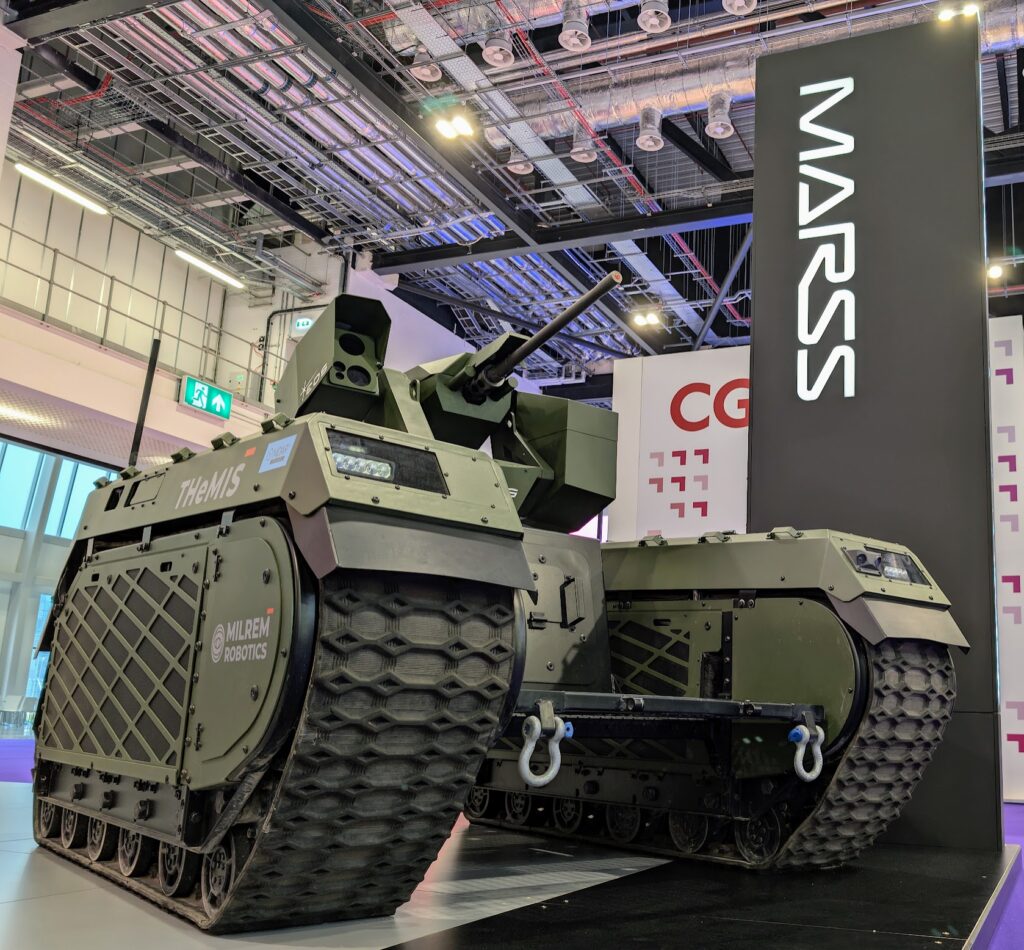
As Robbie Draper, director of Middle East operation for MARSS, explained to ESD at DSEI 2025 on 11 September, while MARSS already has at least one client with UAVs integrated into their NiDAR set-up, how the addition of USVs and UGVs will be added in will depend on a customer’s specific requirements. Meanwhile, the company continues to conduct tests involving manned/unmanned teaming, using platforms such as the Milrem Robotics THeMIS UGV.
A key advantage of the AMM addition to NiDAR, he explained, is that the unmanned platforms do not have to be directly controlled. For example, a UGV can be tasked to move to a specific location, perhaps to investigate suspected activity, simply with a mouse click, leaving the human operator free to perform other tasks that require a human to be in the loop.
While the NiDAR C4 platforms has been used so far by MARSS’ largely Middle Eastern customer base to protect installations and naval bases, Draper noted that the company is developing a scaled-up version of the NiDAR C4 construct. Called Nation Shield, this would go beyond specific locations to cover wider operational sectors. The advantage of this, Draper explained, would be to more widely disseminate a common operating picture, thus allowing higher-level command elements to more rapidly empower units at the more tactical level, given that everyone can see the same common operating picture.
“If you can enact all of that, so that they all know what those pictures are, and they all know what the environment within those pictures is doing at the same time, you can have people forward leaning,” said Draper. “Enabling this thing over one C2 system can enable what goes on at the lowest level. That aids and speeds up tactical, operational and strategic decision making because you are leaning into the decision,” he added.