



European mission and weapon systems house Thales is working to extend the reach of the UK Royal Navy’s surface combatants by integrating its radars – and ultimately missiles – onto rotary-wing unmanned aerial vehicles (UAVs) as part of the Royal Navy’s Maritime Aviation Transformation Strategy.
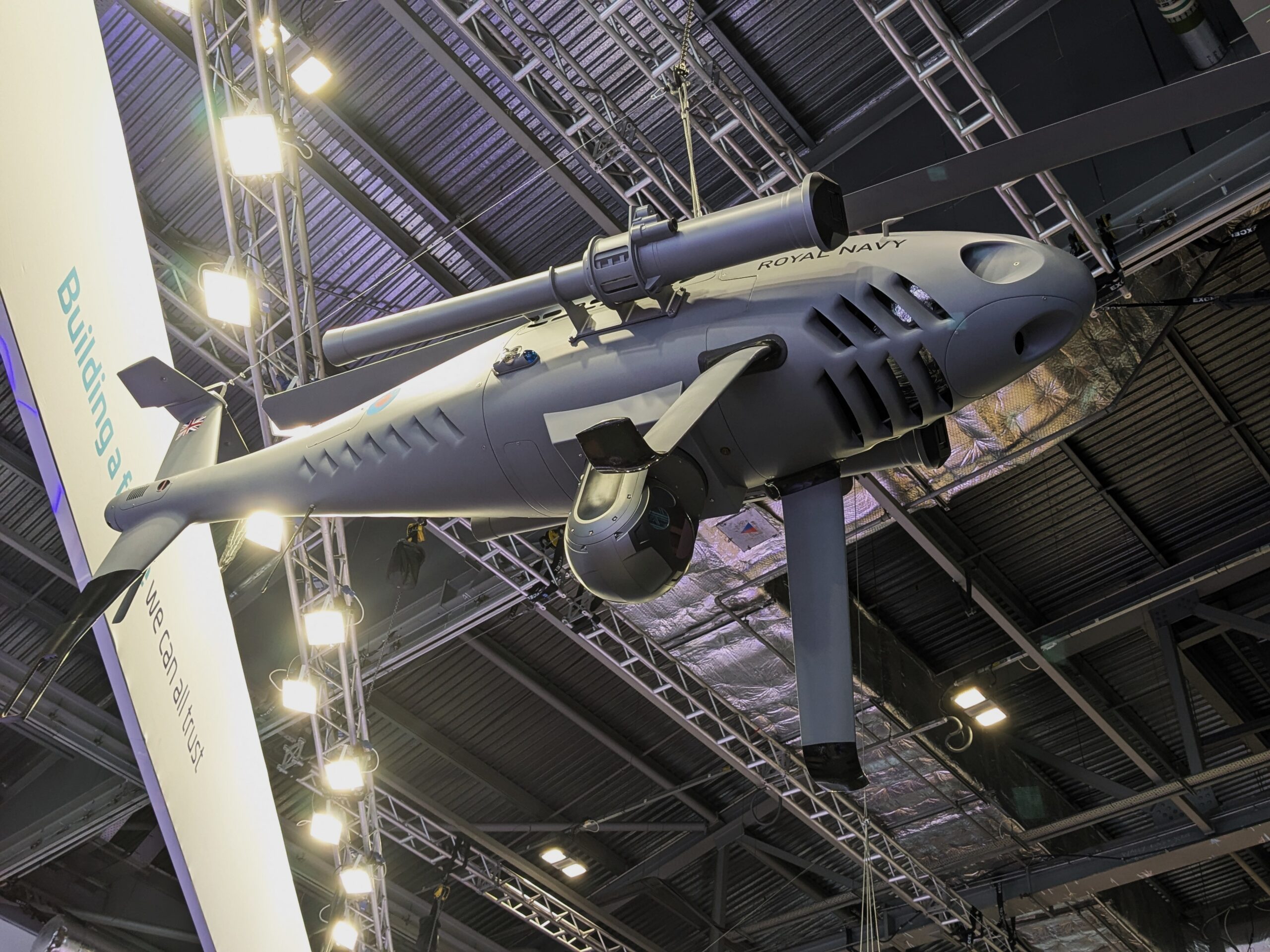
Currently this effort is focused on the Peregrine UAV, which is a Schiebel Camcopter S-100 rotary-wing UAV that carries a Thales I-Master radar optimsed for the maritime environment, a Wescam MX-8 electro-optical/infra-red camera, an automatic identification system (AIS) to identify maritime vessels and Cartenav’s AIMS-ISR mission system to operate as an intelligence, surveillance and reconnaissance (ISR) platform.
The Peregrine UAV was acquired by the Royal Navy in 2023 under the UK’s Future Tactical Uncrewed Air System (FTUAS) programme. It was deployed for the first time aboard the Type 23 frigate HMS Lancaster in early 2025 and has been flying ISR missions in the Gulf, where it has supported counter-narcotics operations. On 11 September 2025 the Royal Navy declared the Peregrine UAV, along with the Malloy Aeronautics T-150 cargo UAV, ready for front-line operations.
As Matthew Moore, deputy sales director for ISR systems as Thales UK, explained to ESD at the DSEI 2025 defence exhibition in London on 10 September, the Peregrine UAV can deploy 150 km beyond its host vessel, with the all-weather range of the radar extending beyond that. Moore explained that the sensor’s range depends on the target, with a large tanker being detectable at around 100 km, while a corvette could be detected at around 40-50 km.
Of the Peregrine operations off HMS Lancaster, Moore said, “What we’re doing is we’re building a picture, a maritime picture of what’s going on out there and interrogating it and understanding it. There are lots of dhows out there doing drug running along the Persian Gulf.” He explained that the Peregrine UAV has also been operating in a manned/unmanned teaming arrangement with the frigate’s Lynx Wildcat helicopter.
While Schiebel’s S-100 has also conducted anti-submarine warfare and mine countermeasures trials by carrying sonobuoy dispensers during NATO’s annual Robotic Experimentation and Prototyping using Maritime Uncrewed Systems (REPMUS) serials in Portugal, Moore explained that one of the key priorities of the Royal Navy is increasing lethality.
Noting that the Lynx Wildcat already carries the Thales Lightweight Multirole Missile (LMM), known as the Martlet in UK service, Moore said, “Our next journey is, ‘Let’s uncrew the lethality options for the navy, so they can start putting uncrewed technology in areas they wouldn’t want to put crewed.’ So what we’re hopefully trying to do next year is bring the LMM/Martlet missile onto the Peregrine as a concept demonstrator, and then tying that to the sensor and the laser beam rider in that sensor to do targeting, and then do a firing next year with that system over a datalink, so we’re going to do uncrewed targeting to increase lethality for the navy.”
The S-100, which has a typical payload capacity of 50 kg, could carry two Martlet missiles. However, Moore noted that, with Schiebel bringing its larger S-300 rotary-wing UAV onto the market, which has a 250 kg payload, Thales is looking to put 10 Martlet missiles on that platform. Thales intends to work on this concept in 2026, although much will depend on how the development of the S-300 goes. The UAV only made its maiden flight in February 2025 and a Schiebel spokesman told ESD at DSEI 2025 that the company hopes to bring the S-300 to market “by the end of next year”.
Moore additionally mentioned that Thales intends to place its latest Airmaster C compact airborne surveillance radar on the Schiebel S-300. Weighing less than 20 kg (10 kg less than the I-Master system) and requiring no integration of any additional accompanying units on board, the Airmaster C is an active electronically scanned-array radar designed for both long and very-close-range target detection and to be autonomous, self-learning and capable of analysing and classifying large volumes of data in a size, weight and power (SWaP) package that is 30% lower than other rival systems.