




Peter Felstead

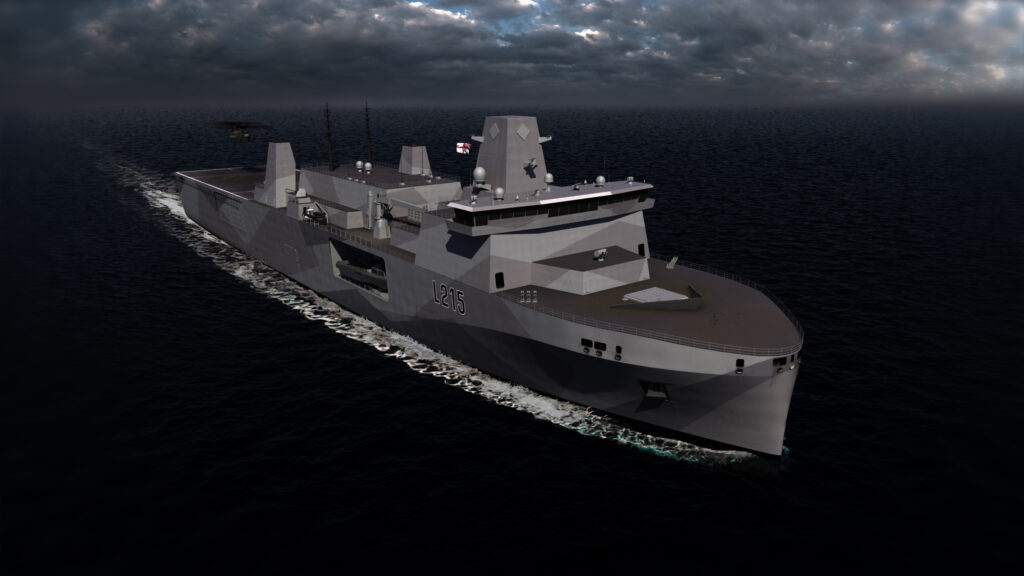
BMT has launched the conceptual design for its Ellida Strike multi-purpose ship. While the design aims to deliver a platform providing flexibility in capability across the operational task spectrum, it brings prominent focus on generating strike capability, especially in high-end amphibious operations.
Ellida Strike was formally unveiled at the DSEI UK 25 defence exposition, held in London from 9 to 12 September. A concept that has been in development since 2024, it is the latest iteration of BMT’s Ellida family (a series focused on large, amphibious shipping).
BMT – a leading international engineering and ship design consultancy – described Ellida Strike as an advanced, adaptable, modular, scalable, forward-looking and future-proofed concept. Alongside its capacity to accommodate capabilities for lower-end military taskings like humanitarian assistance and disaster relief (HADR) operations, it is designed to survive and fight at the high end of the operational spectrum.
“From HADR at one end of the spectrum through to ‘whites of the eyes warfighting’ at the other, and everything in between, Ellida Strike is absolutely the embodiment of that [multi-role] philosophy,” Tim Neild, a retired UK Royal Navy (RN) officer and amphibious ship captain and now BMT’s UK and Europe business development lead, told a media briefing at DSEI 2025. “It’s a warship; it’s not a support ship.”
Neild highlighted several elements of the design’s capability that illustrate the blend between the multi-role baseline and the high-end amphibious outputs. These include a multirole deck and mission bay spaces, which can carry containerised pods including for medical care; a well dock; a flight deck for aviation support; myriad command-and-control facilities; and options for various strike capabilities. “This particular design … will endure out to the 2060s and morph with a navy’s requirements as they evolve over time,” Neild added.
In terms of people, the design offers capacity for a lean core crew of 100-120 sailors plus 600-plus embarked military personnel (such as Royal Marines Commandos).
The capacity to embark a sizable landing force points to the tip of Ellida Strike’s spear. “Ellida Strike is our interpretation of how the amphibious vessel evolves from the traditional Second World War-style ‘many troops over the beach’ [approach] into a more modern platform that is about delivering smaller strike teams at a greater distance, [alongside] providing greater flexibility in what that platform does,” Andy Kimber, BMT’s chief naval architect, told the briefing.
Several navies have requirements for large multi-role ships that deliver high-end amphibious outputs, including the RN with its Multi-Role Strike Ship (MRSS) programme. Kimber was keen to stress that Ellida Strike is not BMT’s design for MRSS, the requirements for which are still to be formalised in the programme’s assessment phase, which is scheduled to start in 2026. Instead, Kimber explained, “What we have been doing is intently listening to what the navy has been saying about the way it wants to deliver capability in the future and, particularly in this context, how the Royal Marines force is developing…. We’ve been looking at how that intent of operation evolves into [a] ship solution.
“Ellida Strike is a vehicle by which we’ve explored a whole range of different things within a single platform,” Kimber continued. “It has helped us understand and explore the features and characteristics that are going to be important in MRSS.”
Such characteristics include the requirement to integrate the conduct of air- and sea-based ship-to-objective manoeuvre (STOM) into a single platform. The RN’s last two amphibious assault ship types – the Ocean-class landing platform helicopter (LPH), and the Albion-class landing platform dock (LPD) – were responsible for conducting air- and sea-based STOM respectively, but carrying out solely that single, dedicated role.
Going forward, such STOM will also have to be unleashed at greater range and speed, with adversaries’ anti-access/area denial (A2/AD) threats in contemporary littoral environments meaning that navies may now be looking at launching amphibious capabilities ashore at distances out to 150 miles (240 km) or more.
“Those [MRSS] ships will have to be faster, stealthier and add more value to the task group from an intelligence, surveillance, and reconnaissance (ISR) perspective, [but] be able to deliver their [amphibious forces] effectively in a fighting order so that they can go and achieve their mission,” Neild explained.