




Peter Felstead

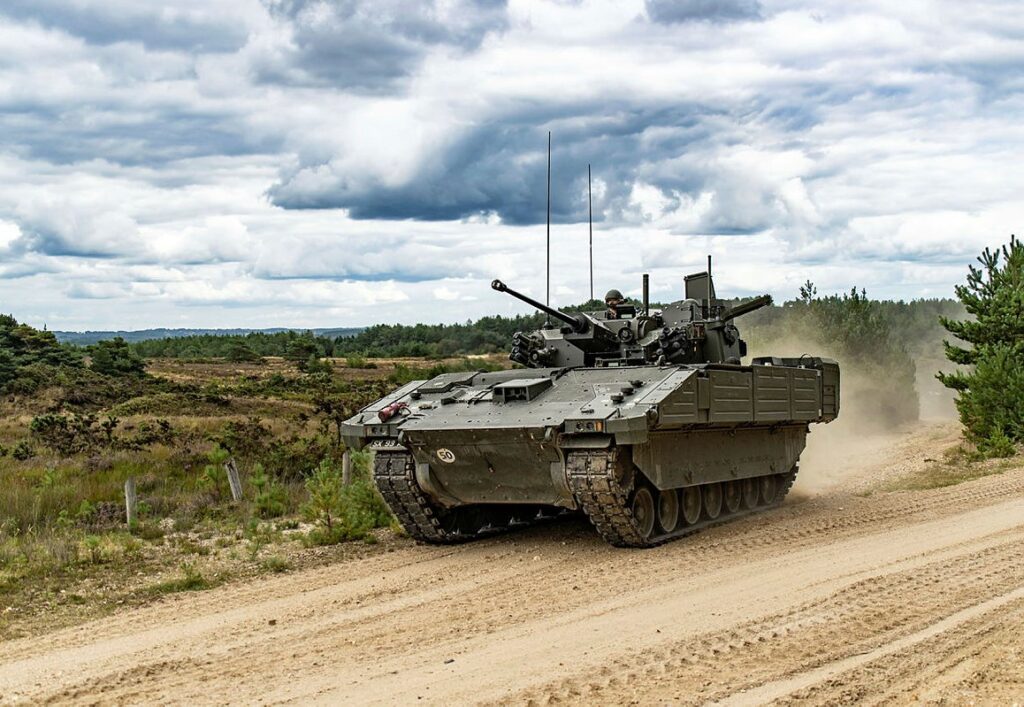
On 6 November 2025 the UK Ministry of Defence (MoD) declared an initial operating capability (IOC) with the Ajax family or tracked armoured vehicles produced by General Dynamics UK (GDUK).
The IOC with Ajax, which amounts to an initial squadron of the British Army’s Household Cavalry Regiment being able to deploy a squadron of 27 Ajax AFVs from a pool of 50, has been a long time coming.
GDUK’s Ajax, which is based on a developed version of GD’s ASCOD tracked platform, was initially selected in 2010, with the UK MoD then ordering 589 Ajax vehicles from GDUK in September 2014 under a fixed-price GBP 5.522 billion (EUR 6.28 billion) contract. That order for 589 vehicles breaks down into seven variants: 245 turreted reconnaissance, surveillance and joint fire control vehicles (with these three types known as Ajax variants); 93 Ares armoured personnel carrier variants; 112 Athena command-and-control variants; 34 Ares formation reconnaissance overwatch variants; 51 Argus engineer reconnaissance variants; 38 Atlas armoured recovery vehicles; and 50 Apollo repair vehicles.
However, in June 2021 it emerged that issues with excessive vibration and noise had led to trials of Ajax variants being halted from November 2020 to March 2021. On 3 June 2022 a report published by the UK House of Commons Public Accounts Committee said the Ajax programme had “gone badly wrong, with no deployable vehicle delivered to date”.
ESD has been told by a highly placed source with intimate knowledge of the Ajax programme that there were three main issues that caused problems with the vehicles’ development. Firstly, a significant resulted from the quality of ASCOD-based platforms being delivered from General Dynamics European Land Systems’ manufacturing site in Spain, which gave the engineers at GDUK’s facilities in Merthyr Tydfil in Wales a number of engineering issues.
Secondly, there was excessive tinkering with the vehicles’ requirements as the project was passed from one desk to another within the British Army/MoD, leading to additional and often unnecessary engineering issues to meet the resulting design revisions.
Lastly, there was an unhelpful reticence from the overarching GD management to concede there were issues to be addressed and to grasp the nettle of addressing them.
By early 2023, however, GDUK had finally got to grips with the programme. When on 22 February 2023 then UK Defence Secretary Ben Wallace visited the British Army’s Bovington Camp in Dorset, where the Ajax vehicles were being trialled, he declared, “We think the remedies are in place, we are now going through the normal trials. … I am confident we have turned the corner on this troubled programme.”
The UK MoD’s Defence Equipment & Support (DE&S) organisation noted on 6 November 2025 that Ajax is the first armoured fighting vehicle to enter service with the British Army in nearly 30 years. DE&S pointed out that, during trials, more than 20,000 rounds have been fired from the Ajax’s Case Telescoped 40 mm Cannon (CT-40 Cannon) and more than 42,000 km have been covered by trials vehicles in battlefield-like conditions.
Thus far, a total of 165 Ajax vehicles have so far been delivered.
The Ajax family of armoured vehicles be at the heart of the British Army’s future armoured and ‘Deep Recce Strike’ brigades. They essentially replace the army’s Combat Vehicle Reconnaissance (Tracked) (CVR(T)) family of vehicles, which first entered service in 1971, but are much larger AFVs weighing 40 tonnes, compared to around 8 tonnes for the average CVR(T) vehicle.
The Ajax family have an open vehicle architecture that can rapidly process data and accommodate future upgrades, while the reconnaissance variants feature a state-of-the-art intelligence, surveillance, target acquisition and reconnaissance (ISTAR) suite.





![Serve to lead. Officer Cadets march past the Old College building during their commissioning ceremony, known as Sovereign’s Parade. [Crown Copyright 2013]](https://euro-sd.com/wp-content/uploads/2025/09/S1-Kopie-218x150.jpg "Serve to lead")