



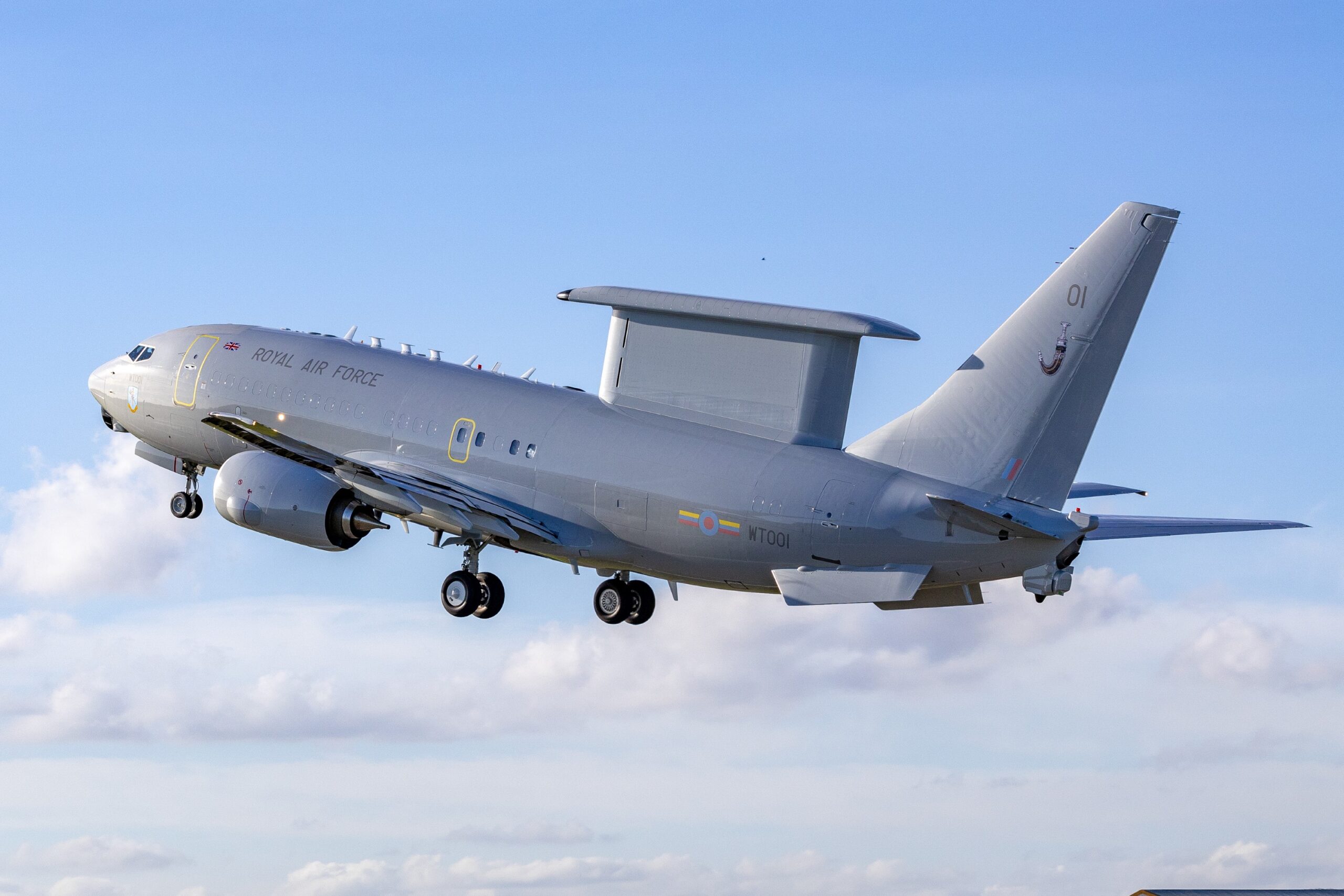

The Netherlands and several NATO European partners have decided to cancel the alliance’s programme to acquire six Boeing E-7 Wedgetail airborne early warning and control (AEW&C) aircraft, the Dutch Ministry of Defence (MoD) announced on 13 November 2025.
The aircraft would have replaced NATO’s fleet of Boeing E-3A Sentry Airborne Warning and Control System (AWACS) aircraft, of which 14 remain of an original fleet of 18 that began operations from 1982.
“These will reach the end of their service life in 2035 and are causing noise pollution,” the Dutch MoD said of the NATO E-3As.
The NATO AWACS fleet operates out of NATO Air Base Geilenkirchen, which is in the German state of North Rhine-Westphalia but literally on Germany’s border with the Netherlands.

“Due to the US withdrawal last July, the replacement programme is now undergoing significant changes,” the Dutch MoD stated. “Under the previous programme, both the strategic and financial foundations were lost. Therefore, the remaining countries, united in the Support Partnership Committee, halted the acquisition of the E-7. The members are now exploring alternatives for fleet replacement and seeking new partners.”
Dutch State Secretary for Defence Gijs Tuinman stated, “The goal remains to have other, quieter aircraft operational by 2035. The US withdrawal also demonstrates the importance of investing as much as possible in European industry.”
The demise of the NATO Wedgetail programme thus leaves the field wide open for Saab’s GlobalEye AEW&C platform, which in November 2023 lost out to the E-7 Wedgetail in a procurement decision made by the NATO Support and Procurement Agency (NSPA).
While the E-7 Wedgetail is based on the Boeing 737 Next Generation commercial airliner, which has a wingspan of 35.8 m, and features a dorsally mounted Northrop Grumman Multi-role Electronically Scanned Array (MESA) radar, the GlobalEye is based on the smaller Bombardier Global 6000/6500 business jet range, which has a wingspan of 28.7 m and carries Saab’s own Erieye Extended Range radar, also dorsally mounted. The smaller size of the GlobalEye increases the number of airports from which it can be deployed.
The E-7 has a range of 6,500 km, while its MESA radar has a maximum detection range of over 600 km in ‘look-up’ mode, when it is scanning upwards towards the horizon, or over 370 km in ‘look-down’ mode when looking for fighter-sized targets.
A base Bombardier Global 6500 has a range of 12, 223 km, although a GlobalEye platform would have a range a little less than this. Meanwhile, Saab states that a GlobalEye operating at 35 000 ft can detect low-level threats (at 200 ft) at distances exceeding 458 km.
The current customers of the E-7 Wedgetail platform are Australia, Turkey (E-7 Peace Eagle aircraft), South Korea and the United Kingdom.
So far the GlobalEye platform is in service with the United Arab Emirates Air Force and on order for the Swedish Air Force.

![Soldiers from the Czech company, part of the EUFOR Multinational Battalion, conducted a series of joint training exercises in Mostar alongside operators from Bosnia’s State Investigation and Protection Agency (SIPA). [EUFOR BiH]](https://euro-sd.com/wp-content/uploads/2025/11/Handshake_EUFOR-BiH-218x150.jpg "2025 in the Western Balkans: A year-end SITREP")
![Initially deployed during Operation Granby, the United Kingdom’s contribution to Operation Desert Storm in 1991, the RAF’s air-launched anti-radiation missile proved to be a radar killer. The missile remained in service, and in the RAF’s inventories, until 2013. [Thomas Withington]](https://euro-sd.com/wp-content/uploads/2025/11/ALARM-Thomas-Withington-Kopie-218x150.jpg "Stratus symbol")
![: US Soldiers assigned to 3rd Battalion, 8th Cavalry Regiment, 3rd Armored Brigade Combat Team, 1st Cavalry Division, Task Force Iron, fire a M1A2 Abrams tank during a live-fire demonstration for Iron Defender 25 at Orzysz Training Area, Poland, on 17 September 2025. [US ARNG/Sgt Eric Allen]](https://euro-sd.com/wp-content/uploads/2025/11/Abrams-firing_US-ARNGSgt-Eric-Allen-Kopie-218x150.jpg "Baltic Security: SITREP")

![The US Navy (USN) carrier USS John C Stennis (left), the French Navy carrier FS Charles de Gaulle, and elements of their strike groups are pictured sailing together in US Fifth Fleet’s area of operations. The US, French, and UK navies are all developing ‘hybrid’ crewed/uncrewed mixes for their carrier airwing capability. [US Navy]](https://euro-sd.com/wp-content/uploads/2025/09/2-HST-CdG-USN-Kopie-218x150.jpg "Hybrid navies: Integrating uncrewed capability into carrier strike")
![The UK aircraft carrier HMS Prince of Wales (foreground) sails alongside the US carrier USS George Washington during Australia’s ‘Talisman Sabre’ exercise in July 2025. The two carrier strike groups (CSGs), plus Australian Navy assets, conducted CSG integration activities. [Crown copyright 2025]](https://euro-sd.com/wp-content/uploads/2025/09/1-PWLS-GW-TSabre-CC-UK-MoD-25-Kopie-218x150.jpg "Strategic shift: UK CSG deployment demonstrates switch in UK strategic focus")
