




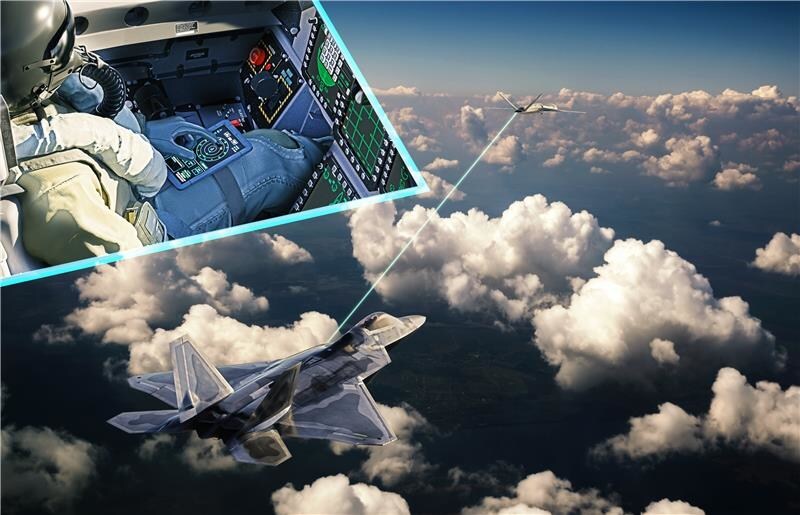
Lockheed Martin’s Skunk Works, working with industry partners and the US Air Force, has controlled an uncrewed aerial vehicle (UAV) from the cockpit of a fifth-generation fighter while in flight, Lockheed Martin announced on 19 November 2025.
The test flight, which took place out of Nellis Air Force Base in Nevada, involved an unspecified UAV and an F-22 Raptor, the pilot of which successfully used a pilot vehicle interface (PVI) in the cockpit to send control directions to the UAV and command it to execute a specific mission profile. The PVI represents a flexible system to provide integration-ready capabilities for both current and future platforms.
“This event demonstrates human-machine teaming capabilities and the future of air combat, today,” stated a company press release. “Lockheed Martin has been focused on the transformative power of autonomous and AI-enabled operations in crewed and uncrewed systems for years, with particular focus on integrating autonomous drones with the F-22 and F-35.”
O J Sanchez, Skunk Works’ vice president and general manager, stated of the test flight, “This effort represents Skunk Works driving a breakthrough in air combat capability, where single-seat aircraft command and control drones with simple and intuitive interfaces in the cockpit.”
Human-machine teaming will be a central part of how in future the US Air Force will adopt a ‘family of systems’ approach to projecting combat air power.
“Human-machine teaming enhances situational awareness, interoperability, survivability and flexibility, unlocking a significant advantage for the US Air Force,” Lockheed Martin stated. “By integrating the F-22 with other advanced systems we’re bolstering the capabilities of our warfighters, ensuring American airpower dominance.”

![French helicopters operating in Mali. Shown here are the Tiger (Top), H225M (background left), and NH90 (foreground, right). [Airbus]](https://euro-sd.com/wp-content/uploads/2025/09/French-NH90H225MTiger-in-Mali-Copyright-Airbus-Kopie-218x150.jpg "New developments in multirole helicopters")


![A German Air Force Eurofighter Typhoon flies through the sky during the Exercise BAANA 2024, Ranua, Finland, on 4 September 2024. [US Army/Sgt Scyrrus Corregidor]](https://euro-sd.com/wp-content/uploads/2025/06/Eurofighter-Typhoon-BAANA_US-ArmySgt-Scyrrus-Corregidor-Kopie-218x150.jpg "How much ‘growth’ is there still in 4th-Gen fighters?")
![President Trump, the 47th President, said that the USAF’s first sixth generation fighter would be known as the F-47, insisting that: “The generals picked a title, and it's a beautiful number…” Trump also noted that “an experimental version of the plane has secretly been flying for almost five years.” [USAF]](https://euro-sd.com/wp-content/uploads/2025/06/2-F-47-8928628-1-Kopie-218x150.jpg "US air dominance: The story so far")
![Pictured: Only once pre-flight checks have taken place to ensure protective gear, such as G-suits, harnesses, helmets, parachutes and more, is adjusted and is working properly, will Warthog pilots head out onto the tarmac for take-off. [USAF/2Lt Benjamin Williams]](https://euro-sd.com/wp-content/uploads/2025/06/1-In-the-cockpit-A-10C-taxis-for-take-off-Credit-USAF-2Lt-Benjamin-Williams-Kopie-218x150.jpg "Improving the odds of survival")