




Peter Felstead

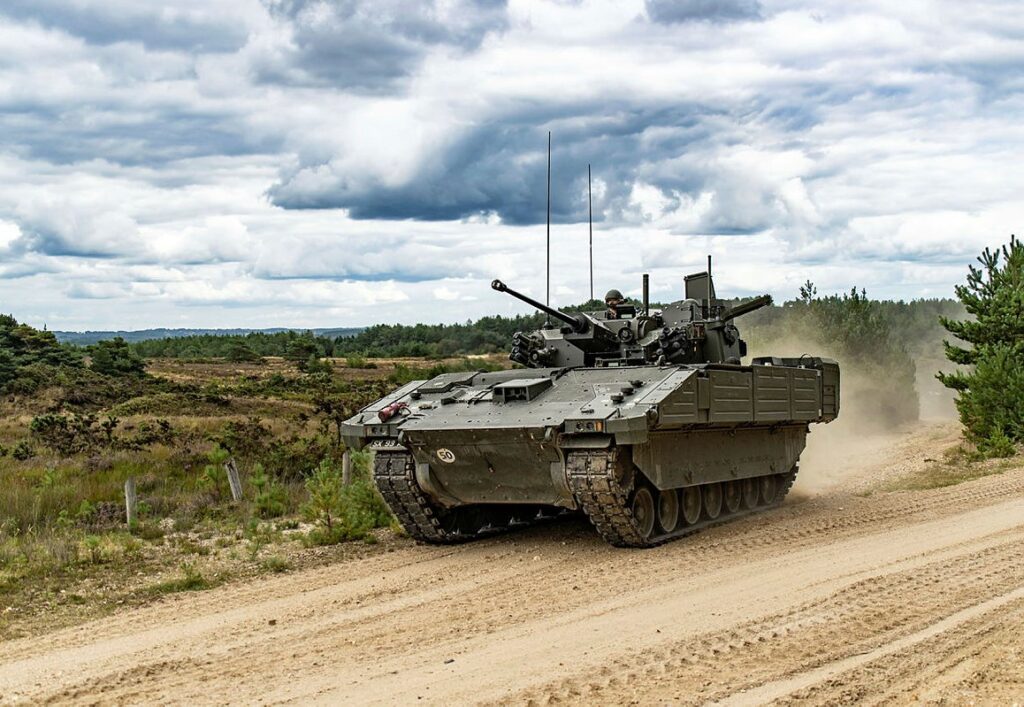
The British Army has again halted all use of its Ajax tracked armoured vehicles as noise and vibration issues continue to affect the health of vehicle crews.
The halt comes despite the UK Ministry of Defence (MoD) declaring an initial operating capability (IOC) with the Ajax family on 6 November 2025, with Defence Readiness & Industry Minister Luke Pollard insisting that the noise and vibration issues with the vehicle had been fixed and that the MoD would not be giving IOC status to “any platform that we did not think was safe for the men and women of our forces to use”.
Meanwhile, at an event in London on 4 November that will now be seen with some irony, the Ajax programme won Megaproject of the Year at the Global Project Controls Expo Awards.
At that point around 165 Ajax vehicles had been delivered.
However, BFBS Forces News reported on 20 November that three members of the Household Cavalry Regiment were facing medical discharge due to injuries sustained since the introduction of Ajax to their unit.
The UK MoD has since confirmed that 31 personnel showed noise and vibration symptoms following Exercise ‘Titan Storm’ which took place on Salisbury Plain from the beginning of November and involved both the Household Cavalry and the Royal Lancers.
The obvious question therefore – for the British Army, as well as the UK MoD and its Defence Equipment & Support organisation – is how is it possible that IOC was declared for a vehicle that continued to pose health risks for the service personnel using it?
On 26 November a written statement made by Pollard to the House of Commons read as follows: “As safety is my top priority, prior to IOC I asked for and was given assurances in writing by senior Ministry of Defence (MoD) personnel that the system was safe. On 22 November 2025 around 30 service personnel operating Ajax reported noise and vibration symptoms during a training exercise. The exercise was stopped immediately in line with our safety protocols and those affected received full medical care and attention, and continue to be monitored. There have not been any hospitalisations and none of the symptoms are life threatening.
“The safety of our service personnel remains a top priority for the MoD. As such, and out of an abundance of caution, I have directed a pause on use of Ajax for training and exercising, while a safety investigation is carried out.”
The Ajax family of tracked armoured vehicles is produced by General Dynamics UK (GDUK) and based on a developed version of GD’s ASCOD tracked platform. Ajax was initially selected in 2010, with the UK MoD then ordering 589 vehicles from GDUK in September 2014 under a fixed-price GBP 5.522 billion (EUR 6.28 billion) contract. That order for 589 vehicles breaks down into seven variants: 245 turreted reconnaissance, surveillance and joint fire control vehicles (with these three types known as Ajax variants); 93 Ares armoured personnel carrier variants; 112 Athena command-and-control variants; 34 Ares formation reconnaissance overwatch variants; 51 Argus engineer reconnaissance variants; 38 Atlas armoured recovery vehicles; and 50 Apollo repair vehicles.
However, in June 2021 it emerged that issues with excessive vibration and noise had led to trials of Ajax variants being halted from November 2020 to March 2021. On 3 June 2022 a report published by the UK House of Commons Public Accounts Committee said the Ajax programme had “gone badly wrong, with no deployable vehicle delivered to date”.
ESD has been told by a highly placed source with intimate knowledge of the Ajax programme that there were three main issues that caused problems with the vehicles’ development. Firstly, a significant resulted from the quality of ASCOD-based platforms being delivered from General Dynamics European Land Systems’ manufacturing site in Spain, which gave the engineers at GDUK’s facilities in Merthyr Tydfil in Wales a number of engineering issues.
Secondly, there was excessive tinkering with the vehicles’ requirements as the project was passed from one desk to another within the British Army/MoD, leading to additional and often unnecessary engineering issues to meet the resulting design revisions.
Lastly, there was an unhelpful reticence from the overarching GD management to concede there were issues to be addressed and to grasp the nettle of addressing them.
By early 2023, however, GDUK appeared to have finally got to grips with the programme. When on 22 February 2023 then UK Defence Secretary Ben Wallace visited the British Army’s Bovington Camp in Dorset, where the Ajax vehicles were being trialled, he declared, “We think the remedies are in place, we are now going through the normal trials. … I am confident we have turned the corner on this troubled programme.”







![Serve to lead. Officer Cadets march past the Old College building during their commissioning ceremony, known as Sovereign’s Parade. [Crown Copyright 2013]](https://euro-sd.com/wp-content/uploads/2025/09/S1-Kopie-218x150.jpg "Serve to lead")
