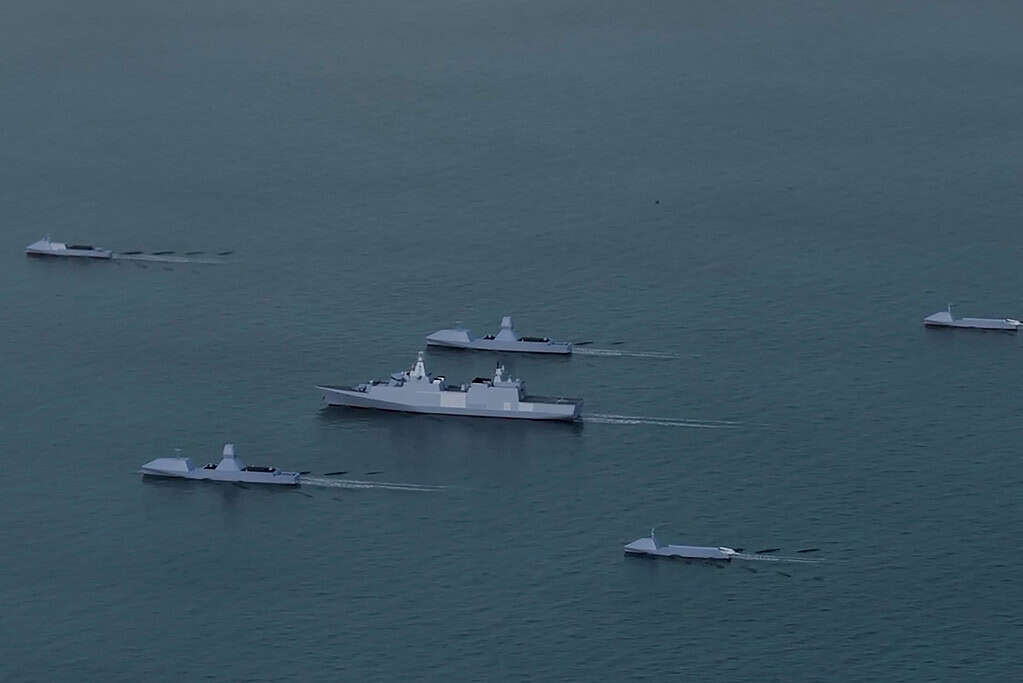





The UK’s Babcock International unveiled on 8 December 2025 its Autonomous and Remote, Maritime Operational Response – Force (ARMOR Force) architecture of disaggregated systems and platforms to support the UK Royal Navy’s (RN’s) next-generation autonomous ambitions.
Working with Huntington Ingalls Industries (HHI), the United States’ largest military shipbuilder, and UK artificial intelligence (AI) defence technology startup Arondite, Babcock intends to “supercharge the delivery of a Hybrid Navy” by creating a Type 31 Common Command Vessel (CCV) capability, enabling the RN’s latest frigates to control a networked force of large autonomous uncrewed vessels and systems.
In addition to Babcock’s T31 CCV, the overall solution includes large unmanned surface vessels (USVs) that can be autonomous or remotely controlled and modular containerised Persistent Operational Deployment Systems (PODS) for rapid capability deployment and mission autonomy. The solution will also involve an autonomous mission system with the aim of being deployable by the end of 2026.
HII is currently developing and constructing the ROMULUS family of USVs, which are engineered for rapid, repeatable production and long endurance at sea. These USVs deliver sustained open-ocean autonomy with a focus on lethality, cost efficiency and scalability. Complementing this, Babcock will design and manufacture the handling system to embark and disembark PODS onto large ROMULUS USVs, offering customers more diverse capabilities.
Meanwhile, Arondite’s Cobalt Operating System will serve as the autonomy and mission orchestration layer across ARMOR Force, integrating crewed and uncrewed platforms into unified fleets that can be commanded from sea or shore. Together Babcock and Arondite are collaborating on the design, development and deployment of a range of AI-enabled, interoperable and autonomy-native maritime systems for the RN and navies globally.
“ARMOR Force is our response to the First Sea Lord’s call for a re-imagined Hybrid Navy,” Sir Nick Hine, chief executive of Babcock’s Marine sector, was quoted as saying in a company press release. “ARMOR Force and the partnerships we are creating with HII and Arondite represent a bold step forward. We are combining advanced autonomy, modular systems and digital innovation to create a fleet that is more agile, resilient and ready for tomorrow’s challenges. What we are proposing will keep the Royal Navy at the forefront of global maritime security for decades to come and redefine what is possible at sea.”
Chris Kastner, president and CEO of HII, was quoted as saying, “HII is proud to be part of this game-changing industry initiative to deliver a Hybrid Navy concept for the Royal Navy and international markets. Partnering with Babcock strengthens HII’s ability to deliver ROMULUS for the ARMOR Force and to support the Royal Navy’s vision for the future fleet. The ROMULUS family of USVs brings scale, autonomy and real operational advantage, and HII adds world-leading expertise across land, sea, and air – as well as the capacity to innovate at scale with a platform already in production.”
Will Blyth, co-founder and CEO, Arondite, added, “The future of maritime power will be defined by an adaptable blend of crewed and uncrewed systems, leveraging disaggregated sensors and effectors. We have built Cobalt to tackle exactly this challenge. We are proud to combine our autonomy and mission orchestration capabilities with the world-leading integration, design and build expertise of Babcock and HII, to rapidly deliver the Royal Navy’s vision of a Hybrid Navy.”
Built on open commercial and NATO standards, ARMOR Force technology is also designed to work alongside allied forces.