


Peter Felstead

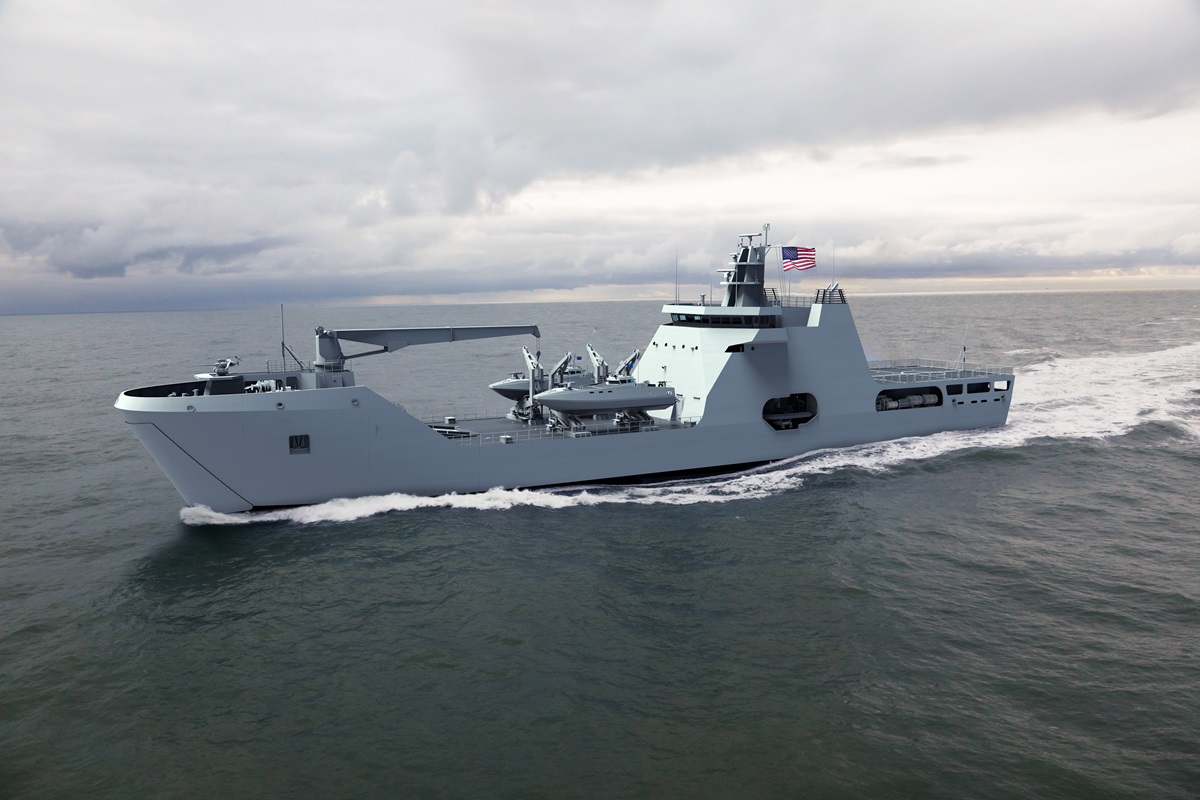
Damen Shipyards Group announced on 9 December 2025 that its Landing Ship Transport (LST) 100 design has been selected by Naval Sea Systems Command (NAVSEA). According to the US Navy, up to 35 LST100 vessels will be constructed at shipyards in the United States for its Landing Ship Medium (LSM) programme, which aims to enhance capability to transport and US Marine Corps units in contested environments.
NAVSEA released a request for information for the LSM programme to industry at the beginning of 2025. Following this, in July, Damen received a technical data package (TDP) award from NAVSEA for the LST100, with the design now selected as the basis for the LSM class.
To ensure speed of delivery to the fleet, the US Navy was seeking a non-developmental seagoing vessel design. Damen has previously delivered an LST100, providing the opportunity for NAVSEA representatives to visit an in-service example for themselves.
Additionally, last year the Australian government announced its selection of the LST100 for the Australian Defence Force’s Landing Craft Heavy programme, under which up to eight vessels will be constructed by Australian shipyards.
The LST100 is 100.68 m long with a beam of 16 m and a draught of 3.58 m. It.
With its ability to transport personnel, vehicles, equipment and cargo, the vessel is suited to a diverse range of operations and can be used in patrol, landing, survey and reconnaissance operations, as well as for the delivery of humanitarian aid and disaster relief.
In its standard design the LST100 features bunks for 282 personnel. Cargo can be transported on the RoRo deck (500 m2), vehicle deck (400 m2) and on the helicopter deck. The vessel is able to sail at speeds of up to 14 kts (26 km/h) to a range of 3,890 nautical miles (7,204 km), while at an endurance speed of 10 kts it can reach up to 7,530 nautical miles (13,946 km).
The LST100 features extensive flexibility, with a modular design that enables straightforward adaptation and upgrade without compromising the benefits of standardisation. For example, with the addition of a standard, 20 m modular block, the vessel can be enlarged to the LST120 design during construction.
Damen area manager for the Americas Alan Borde was quoted in a company press release as stating, “We are delighted at NAVSEA’s selection of the LST100 for its LSM programme. We are very much looking forward to continuing our co-operation with American shipyards during the construction of these vessels in the coming years. We enjoy long-standing relationships with a number of these yards, having supported their construction of our vessel designs over the last decades.”


![During RIMPAC 2024, USN crew successfully 3D-printed a replacement part onboard USS Somerset. [US Navy]](https://euro-sd.com/wp-content/uploads/2026/01/LPD-25-USS-Somerset-088-Kopie-218x150.jpg "From logistics to liability: Bridging the ‘trust gap’ in naval 3D printing")