



Peter Felstead

The US 2025 National Security Strategy, published on 4 December 2025, will have left all but a few pro-Russian European political and military leaders in little doubt of the disdain with which they are now held by the administration of US President Donald J Trump.
If Trump is known for his unconcealed narcissism and lack of empathy, then the outlining of the United States’ future security posture is nothing less than a national version of that writ large. Everything is perceived through the prism of what is most advantageous for US interests, with the strategy stating that “The days of the United States propping up the entire world order like Atlas are over” and that “the affairs of other countries are our concern only if their activities directly threaten our interests”.
Meanwhile, despite the burgeoning military power of China and a belligerent Russia in Europe, the strategy appears to cast illegal migration as a primary threat, not just to the United States but also to its erstwhile European allies.
With an overriding concentration on the Western Hemisphere, the National Security Strategy states as a goal, “We want to ensure that the Western Hemisphere remains reasonably stable and well-governed enough to prevent and discourage mass migration to the United States.”
Moreover, the strategy overtly asserts that the United States “will assert and enforce a ‘Trump Corollary’ to the Monroe Doctrine, referring to the US 19th Century foreign policy initiative that opposed European colonialism in the Western Hemisphere and effectively claimed US jurisdiction over the Americas.
This 19th Century outlook in the 2025 National Security Strategy doesn’t stop there; the increasingly vital space domain, for example, is almost entirely absent from the document.
It is Europe, however, that receives a particular shellacking in the strategy. Perhaps this should not come as a great surprise, given US Vice President J D Vance’s verbal assault on European leaders at the Munich Security Conference on 14 February 2025, in which he ignored Russia’s 2022 invasion of Ukraine and instead accusing European leaders of suppressing free speech and failing to halt illegal migration.
The US 2025 National Security Strategy again takes up this mantle, claiming that Europe’s “economic decline is eclipsed by the real and more stark prospect of civilizational erasure”. It claims that the larger issues facing Europe “include activities of the European Union and other transnational bodies that undermine political liberty and sovereignty, migration policies that are transforming the continent and creating strife, censorship of free speech and suppression of political opposition, cratering birthrates, and loss of national identities and self-confidence”.
Turning to the Ukraine War, the strategy document states, “It is a core interest of the United States to negotiate an expeditious cessation of hostilities in Ukraine, in order to stabilize European economies, prevent unintended escalation or expansion of the war, and reestablish strategic stability with Russia, as well as to enable the post-hostilities reconstruction of Ukraine to enable its survival as a viable state”.
The National Security Strategy states that “many Europeans regard Russia as an existential threat”. This is certainly true, but stating it in this manner implies that the United States does not: a stance that no doubt has the Republican Presidents of the Cold War turning in their graves.
Meanwhile, despite the professed ‘Trump Corollary’ to the Monroe Doctrine, the new US National Security Strategy asserts that a future US goal “should be to help Europe correct its current trajectory”.
The new US strategy also plays the illegal immigration card in casting a shadow on the NATO alliance, claiming, “Over the long term, it is more than plausible that within a few decades at the latest, certain NATO members will become majority non-European. As such, it is an open question whether they will view their place in the world, or their alliance with the United States, in the same way as those who signed the NATO charter.”
While National Security Strategy claimed as a goal that “We want to support our allies in preserving the freedom and security of Europe”, it immediately added the United States would do this “while restoring Europe’s civilizational self-confidence and Western identity”. In other words, the Trump Administration claims a right to meddle politically in Europe with the aim of rendering European states in its own image, despite previously asserting that the United States would be “respectful of other countries’ differing religions, cultures, and governing systems”.
European reaction to the US 2025 National Security Strategy appeared to accept the new reality with regard to the continent’s relationship with the United States while rejecting the tenets of the US strategy.
European Council President Antonio Costa, addressing the Jacques Delors Institute think tank in Paris on 8 December, stated, “We need to focus on building a Europe that must understand that the relationships between allies and the post-World War II alliances have changed,” adding that “What we cannot accept is this threat of interference in Europe’s political life.”
German deputy government spokesman Sebastian Hille stated at a press briefing in Berlin on 8 December, “We reject the partly critical comments directed at the EU. Political freedoms, including the right to freedom of expression, are among the fundamental values of the EU. We view attacks in this regard as ideology rather than strategy.”
An article authored by Laurel Rapp, director of the US and North America Programme for the UK-based Royal Institute of International Affairs think tank, and published by the institute on 9 December, stated, “President Donald Trump’s national security strategy landed with a thud across Europe and to toasts in Beijing and Moscow. … Close Trump confidantes have infused a disdain for Europe into the text: a strong transatlantic relationship is no longer thought critical to US national security. In this strategy, commercial arrangements can override values. Great powers can coexist by limiting meddling in each other’s regions. And strength matters.”
With regard to China, the 2025 National Security Strategy asserted that Trump “single-handedly reversed more than three decades of mistaken American assumptions about China: namely, that by opening our markets to China, encouraging American business to invest in China, and outsourcing our manufacturing to China, we would facilitate China’s entry into the so-called ‘rules-based international order’, adding that, “This did not happen. China got rich and powerful, and used its wealth and power to its considerable advantage.”
While stressed the importance of countering China economically, the strategy nevertheless stated that, “Importantly, this must be accompanied by a robust and ongoing focus on deterrence to prevent war in the Indo-Pacific.”
The strategy additionally stated that “deterring a conflict over Taiwan, ideally by preserving military overmatch, is a priority” and that the United States “does not support any unilateral change to the status quo in the Taiwan Strait”.
Yet by the Trump Administration concentrating its efforts on the Western Hemisphere in the enforcement of a ‘Trump Corollary’ to the Monroe Doctrine, how is a strong focus on the Asi-Pacific to be maintained?
The strategy asserted that the United States “will build a military capable of denying aggression anywhere in the First Island Chain [the strategic arc of islands in the Western Pacific]” but added that “the American military cannot, and should not have to, do this alone. Our allies must step up and spend – and more importantly do – much more for collective defense”. The strategy thus stressed increased burden-sharing with allies such as Japan and South Korea.
As regards the Middle East, the new US National Security Strategy concedes that “conflict remains the Middle East’s most troublesome dynamic”, but claims that “Israeli actions since October 7, 2023, and President Trump’s June 2025 Operation Midnight Hammer, which significantly degraded Iran’s nuclear program”, has dissipated this issue.
The strategy asserts that, “As this administration rescinds or eases restrictive energy policies and American energy production ramps up, America’s historic reason for focusing on the Middle East will recede.”
With regard to the United States’ own military capabilities, the US National Security Strategy stated, “A strong, capable military cannot exist without a strong, capable defense-industrial base. The huge gap, demonstrated in recent conflicts, between low-cost drones and missiles versus the expensive systems required to defend against them has laid bare our need to change and adapt. America requires a national mobilization to innovate powerful defenses at low cost, to produce the most capable and modern systems and munitions at scale, and to re-shore our defense industrial supply chains.
“We want the world’s most robust, credible, and modern nuclear deterrent, plus next-generation missile defenses – including a Golden Dome for the American homeland – to protect the American people, American assets overseas, and American allies.”
Inevitably, the new US National Security Strategy claimed President Trump has cemented his legacy as ‘the President of Peace’ and cited eight international conflicts where Trump had “leveraged his dealmaking ability to secure unprecedented peace”. These claims are mostly dubious at best; in at least some of those conflicts – fighting in the Democratic Republic of Congo and Gaza, for example, and in the conflict between Cambodia and Thailand – military action or deadly violence continued as of mid-December. Meanwhile, and despite the National Security Strategy purporting to espouse a “predisposition to non-interventionism”, Trump over the last several weeks has been increasingly threatening the regime of Venezuelan President Nicolás Maduro with US military action. The Trump Administration cites narco-trafficking to the United States as the premise for its military threats against Venezuela – and for the US Navy killing the operators of drug boats in the Caribbean and elsewhere – yet on 1 December Trump pardoned the former president of Honduras, Juan Orlando Hernández, who had been sentenced by a US District judge to 45 years in prison last year for using his position to help drug traffickers import more than 400 tons of cocaine into the United States.
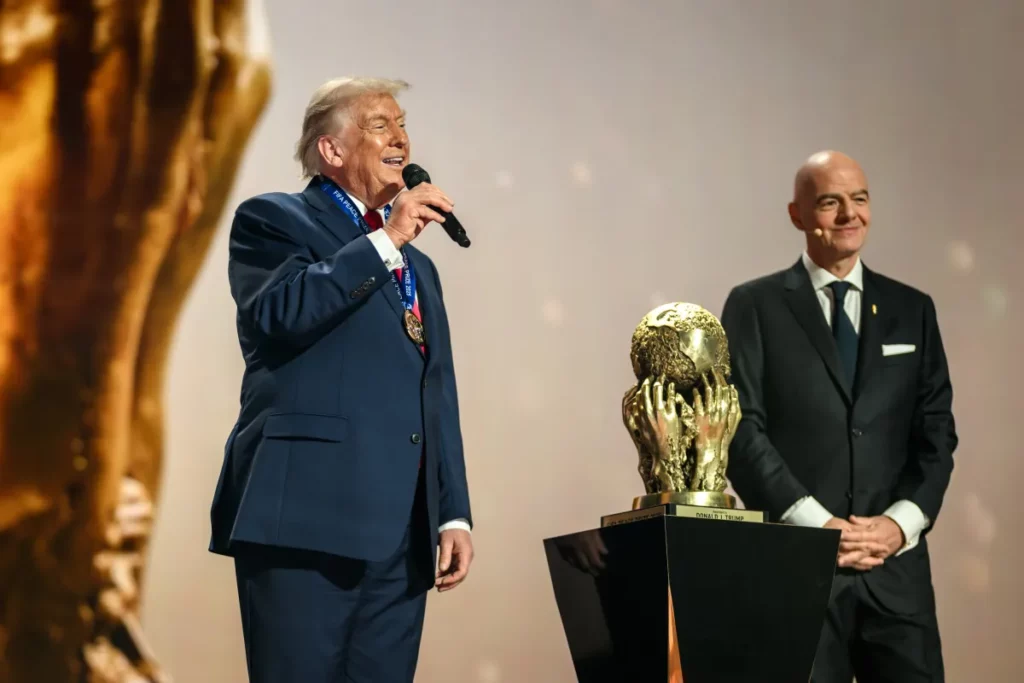
Trump’s assertion that he is ‘the President of Peace’ appears to be part of his relentless campaign to win a Nobel Peace prize. However, the only peace award Trump has received thus far was one fabricated by FIFA President Gianni Infantino and handed to Trump at the 2026 World Cup draw in Washington, DC, on 5 December. Organisations such as human rights campaign group FairSquare have pressed FIFA’s ethics committee to investigate this for multiple breaches of the international football organisation’s political neutrality rules.