


![Following the decommissioning of the Air Defence Anti-Tank System (ADATS) in 2011, the Canadian Army spent 13 years without any GBAD assets until receiving its first RBS 70 NG systems in 2024. While Canada is an extreme example, Ottawa was not alone in a trend that saw many downsize and even eliminate GBAD. [Canadian Army]](https://euro-sd.com/wp-content/uploads/2026/01/Canadian-RBS-70-NG-Kopie.jpg "Canadian RBS 70 NG Kopie")

Ground-based air defence (GBAD) has emerged as one of the dominant procurement priorities of the decade, with military and political leaders across Europe increasingly uneasy at the scale and variety of aerial threats revealed by the war in Ukraine. This concern reflects a hard reality: many European states lack meaningful quantities of modern air defence systems, and the deterrent value these capabilities provide has eroded as inventories have dwindled since the end of the Cold War.
To address the GBAD deficit, several nations have already begun large-scale procurement efforts to replenish or, in some cases, completely rebuild sovereign air defence capabilities. Although long-range air defence (LRAD) systems such as PATRIOT often receive the most attention, very short-range air defence (VSHORAD) and short-range air defence (SHORAD) remain the most relevant instruments for protecting ground formations. Unlike their Cold War predecessors, today’s defence planners must contend with an expanded threat environment that includes not only fixed- and rotary-wing aircraft and cruise missiles, but also a diverse range of unmanned aerial vehicles (UAVs), from sub-10 kg Group 1 quadcopters to high-altitude intelligence, surveillance, target acquisition, and reconnaissance (ISTAR) platforms and mass-produced one-way attack (OWA) munitions, to name just a few from a variety of expected threats.
Meeting this challenge will require ground formations to field far greater quantities of air defence platforms than has been typical over the past three decades. These systems must be mobile enough to accompany dispersed manoeuvre units, and critically, their engagement methods must be cost-effective against increasingly low-cost aerial threats. Achieving this balance will demand shorter procurement cycles, greater use of off-the-shelf solutions, and resistance to institutional tendencies favouring bespoke or overly complex systems.
Air defence in the Armed Forces
Air defence encompasses a range of measures designed to deter, disrupt, or destroy hostile aerial activity. The UK’s Ministry of Defence (MoD) defines it as the effort “to nullify or reduce the effectiveness of enemy air and missile threats through active or passive measures”, employing various assets.
Ground-based assets form the backbone of many national air defence postures. Practically every military possesses a land force component, but not all have sufficient air or naval components able to shoulder any responsibility for air defence. Typically, assets like V/SHORAD systems are assigned to ground formations, whereas medium-range air defence (MRAD) and LRAD systems may sit mostly under joint or air-force control, even if ground-based.
In practice, the distribution of responsibilities varies considerably. The UK’s Armed Forces, for example, rely heavily on air and naval assets for homeland air defence, with ground-based systems providing only point defence. Although the British Army fields both the Lightweight Multirole Missile (LMM) and the CAMM-based Sky Sabre surface-to-air missile (SAM) system, these assets are too few in number to guarantee coverage for deployed ground formations. In a high-intensity conflict, the Army need to rely on the Royal Air Force achieving air supremacy, or on their air assets being diverted to support ground units in the defensive counter-air role – a precarious assumption in a potential peer conflict.
The UK is far from alone. Many NATO armies face similar constraints, having reduced or disbanded air defence units during the post-Cold War peace dividend. Rebuilding organic air defence capacity has therefore become a recurring theme across Western rearmament plans.
Ensuring that air defence is not concentrated solely within air or naval components is essential. While devolving responsibility across the armed forces increases the pool of available assets, it must not encourage complacency from individual domains. Given the persistence and proliferation of low-altitude threats – particularly UAVs and loitering munitions – ground formations require organic air defence measures. This demands not only dedicated SHORAD units but also the integration of secondary air defence capabilities across a wider range of land systems, including counter-UAV (C-UAV) sensors, soft- and hard-kill systems, and distributed man-portable air defence systems (MANPADS) teams, among other measures.
Layered defence in a complex threat environment
The modern threat environment is characterised by a high density of guided munitions and uncrewed platforms, enabled by the reduction in the cost of designing and producing such aerial objects. Ground formations now face an array of threats that vary widely in size, speed, altitude, and lethality. No single system can counter the entire spectrum effectively, making a layered air defence architecture essential. This may consist of organic VSHORAD, SHORAD, and access to joint MRAD or LRAD assets.
VSHORAD
![MANPADS provide short-range point defence and require minimal training to use, although risks of friendly fire do necessitate command-and-control systems be in place to defog the air above combat zones. [Ukrainian MoD]](https://euro-sd.com/wp-content/uploads/2026/01/Ukrainian-FIM-92-Stinger-Kopie-1024x694.jpg)
coptions can include small arms enhanced with miniaturised fire-control systems for small arms (such as SMASH), machine gun and medium-calibre cannon-based systems, man-portable air defence system (MANPADS) and similar small-dimension missiles, along with emerging high-energy laser (HEL) and high-power microwave (HPM) effectors. The increasing availability of these systems allows non-specialist units to field credible organic VSHORAD without reliance on dedicated air defence units.
SHORAD
Dedicated SHORAD units extend engagement ranges out from approximately 8 km out to around 25 km, though again definitions vary and some place the edge of this band slightly lower than this.
Systems in this range band typically employ missiles larger than MANPADS, such as the , or the Tor-M2. Though having said that, there are MANPADS missiles which could be considered SHORAD class under some definitions. While MANPADS have retained broadly similar form factors, thanks to advances in rocketry, modern variants have improved range performance. Consequently, systems such as Roketsan’s Sungur now offer ranges approaching 8 km, greatly expanding their coverage up from legacy designs such as Stinger whose range hovered around 5 km.
![Another trend away from bespoke design is utilising air-to-air missiles shared with air forces for ground-launch use from SAM systems. NOMADS (pictured here) is stated to be able to launch both IRIS-T SLS and AIM-9X. [Kongsberg]](https://euro-sd.com/wp-content/uploads/2026/01/Kongsberg_s-NOMADS-Kopie-1024x682.jpg)
MRAD
MRAD and LRAD capabilities have traditionally fallen under joint or air force commands. However, several recent platforms show that medium-range systems can now deliver the mobility and independence required to operate within land formations.
MRAD and LRAD capabilities have traditionally fallen under joint or air force command structures, and within Western forces mobile MRAD systems remain relatively scarce, in contrast to Soviet air defence developments which placed substantial emphasis on providing mobile MRAD assets to ground formations. A limited number of modern truck-mounted systems now exist that offer engagement envelopes consistent with MRAD requirements; among them is Rafael Advanced Defense Systems’ Spyder All-in-One, which can employ Python-5, I-Derby SR, or I-Derby ER interceptors, achieving ranges of up to 40 km with the latter. The ‘All-in-One’ designation reflects the launch vehicle’s integration of a telescopic mast carrying a four-sided phased-array surveillance and fire-control radar, allowing the launcher to detect, track, and engage targets independently of external sensors.
European V/SHORAD rearmament
Across Europe, many states are now procuring or reassessing their air defence requirements, but clear regional patterns remain. One of the most striking divides lies between long-standing NATO members, which often downsized ground-based air defence after the Cold War, and post-1989 joiners, many of which retained a stronger institutional memory of Soviet-style air defence integration into the land forces. Poland sits firmly in the latter category.
Poland began its air defence recapitalisation earlier than most European nations. Although it inherited a broad inventory of Warsaw Pact systems, the Polish Army maintained the Soviet-influenced principle that land forces should possess a wide mix of ground-based air defence assets. Throughout the 1990s and early-2000s, despite pressures resulting from economic reforms, Poland continued to modernise and sustain domestic industry capable of upgrading legacy systems. This effort included both the refinement of Soviet designs and their gradual adaptation to NATO standards where possible.
As a result, Poland has been able to field credible indigenous V/SHORAD systems for its land forces. The Grom and more recently the Piorun MANPADS have become central to Poland’s short-range capability, with the latter having seen recent export success to the Baltics and Norway.
![The CAMM-based Mała Narew provides a quick option to procure more SHORAD systems for Poland’s land forces, while the MRAD CAMM-ER-equipped Narew is expected to be delivered in the latter-half of the 2020s. [Polish MoD]](https://euro-sd.com/wp-content/uploads/2026/01/Polish-Mala-Narew-Kopie-1024x687.jpg)
While the primary Narew batteries and Poland’s PATRIOT units will fall under the Air Force to deliver wide area air and anti-missile defence, Mała Narew is designed explicitly, in the words of the Polish MoD, “to provide cover to troops and facilities in the area of operations”. This shows intent to ensure that manoeuvre formations in the land forces receive mobile ground-based protection to complement the remaining 2K12 Kub and 9K33 Osa systems, some of which have already been transferred to Ukraine and are reaching their lifespan limits.
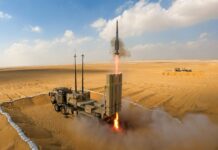
Germany presents a sharply contrasting example. More explicitly than even the UK, Germany dismantled its dedicated army air defence branch, the Heeresflugabwehrtruppe, in 2012. Today, the few remaining ground elements are confined to Luftwaffe anti-aircraft units equipped with Stinger MANPADS for point defence of air bases and critical infrastructure. Medium- and long-range responsibilities also lie within the Luftwaffe, which operates nine Patriot batteries – with eight more on order – and will be fielding IRIS-T SLM in the near future. As a result, the Bundeswehr currently has no meaningful organic SHORAD capability to protect its ground formations and would be forced to rely on Luftwaffe assets or NATO allies during combat operations.
![Skyranger 30 is one of a growing trend of standalone air defence turrets that can be equipped onto a variety of wheeled and tracked platforms, with energy, size, and weight requirements being the main factors into what it can be integrated onto. [Chris Mulvihill]](https://euro-sd.com/wp-content/uploads/2026/01/Skyranger-30-on-Leopard-2A4-Kopie-1024x768.jpg)
Challenges for air defence procurement
Even when defence ministries recognise the need to expand their air defence inventories, obstacles frequently arise within the procurement and industrial process itself. Many European states are now seeking to acquire identical or comparable systems at the same time and often from the same industry suppliers, resulting in growing backlogs across the sector. Production bottlenecks are particularly visible in the missile domain: Stinger output, for example, is currently limited to a reported 60 units per month, which consists of refurbished or modernised rather than new-build systems. As this production rate is shared across American, allied, and Ukrainian demands, this illustrates an increasingly bleak outlook for states that have yet to join the lengthy procurement queues forming around in-demand air defence systems.
A second structural issue lies in how procurement agencies conceive acquisition cycles. Conventional multi-year processes – drafting requirements, issuing requests for information (RFIs), conducting competitive tenders, and then running extended trials – cannot keep pace with the rapid technological turnover now occurring on the battlefield. According to an article published by David Kirichenko in the Australian Strategic Policy Institute, some battlefield technologies utilised in the Ukrainian conflict now have effective lifespans as short as four to six weeks before requiring modifications and changes to remain effective. Nowhere is this more evident than in the ongoing contest between micro-UAVs and electronic-warfare (EW) countermeasures, where each side iteratively adapts new techniques and counter-measures in a matter of days and weeks.
Against this background, the traditional model of acquiring large, bespoke systems has become increasingly misaligned with reality. The US Army’s Indirect Fire Protection Capability (IFPC) programme is an example. IFPC Increment 1 began in 2004 with the goal of fielding a mobile system capable of defeating cruise missiles, UAVs, and rocket, artillery, and mortar (RAM) threats. It was intended to fill the SHORAD gap, engaging threats below the level of long-range assets such as PATRIOT and THAAD for the US Army. After more than two decades of development, several restructurings, and repeated delays, the programme’s Increment 2 capability (awarded a USD 237 million prototyping contract in 2021) is not expected to enter service until 2029–30. While IFPC is perhaps atypically protracted, it is emblematic of a wider pattern in which long procurement cycles, cost overruns, and slow decision-making leave forces without timely capabilities.
![Frankenburg Technologies is among several that claim to use similar design and production methods that opponents use for their novel aerial threats, relying on commercially-accessible dual-use components and promising ‘good enough’ specifications to provide lower costs. [Frankenburg Technologies]](https://euro-sd.com/wp-content/uploads/2026/01/Frankenburg-Mk1-Kopie-1024x576.jpg)
However, it remains to be seen whether or not Frankenburg’s Mk 1 missile offering, with a reported cost of USD 50,000 per missile represents a sufficient price-to-performance proposition. By way of comparison, according to a December 2014 speech by IDF Brigadier-General Dr Daniel Gold, the Tamir missile used by Iron Dome had a cost of USD 50,000 per missile in 2014 (equivalent to around USD 68,425 in 2025 dollars). The Tamir missile also possesses a much greater engagement range of 10 km, compared to the Frankenburg Mk 1’s 2 km. Cost per engagement represents a critical factor in air defence planning, given the sheer scale of the modern drone threat; as seen in Ukraine, Russian aerial attacks can comprise many hundreds of Geran OWA UAVs, alongside lower numbers of cruise and ballistic missiles.
Looking ahead
Europe now faces an air threat more varied and dynamic than at any point since the Cold War. Ground formations require organic, mobile, layered air defence, and procurement cycles must accelerate accordingly to achieve this in an appropriate timeframe. The growing density and diversity of aerial threats means that air defence can no longer be confined to specific branches, nor even solely to traditional air defence units. As has been widely demonstrated in Ukraine, manoeuvre formations are persistently exposed to micro-UAVs, FPV drones and various guided munitions. No single system can provide total protection; air defence must therefore become both layered and broadly distributed across ground formations.
A central requirement is the integration of secondary air defence capabilities into non-specialist units. Infantry elements will increasingly need access to MANPADS in large quantities, optical fire-control systems on small arms, and man-portable EW devices. Armoured and mechanised formations may rely more heavily on RWSs with airburst ammunition and basic UAV detection sensors. Soft-kill options such as jammers represent an affordable addition for a wide range of platforms. With industry frequently emphasising modular and upgradeable architectures, procurement agencies should exploit the ability to retrofit in-service vehicles with additional defensive and sensor suites, ensuring ground formations can adapt as aerial threats continue to evolve.
Chris Mulvihill


![Developed by the Australian company Droneshield. the Dronegun Tactical uses·directional antennas to deliver RF energy intended to disrupt control, video, and navigation signals across multiple frequency bands, and to prevent the target from using satellite navigation. [Droneshield]](https://euro-sd.com/wp-content/uploads/2025/09/Dronegun-Tactical-Droneshield-Kopie-218x150.jpg "Countering small drones: A big challenge")
![IRIS-T SLM key system components viewed from above, consisting of the command post (left), transporter, erector, launcher (TEL; middle), and radar (right). This system forms the MRAD component of ESSI. [Diehl Defence]](https://euro-sd.com/wp-content/uploads/2025/08/IRIS-T-SLM-system-components_Diehl-Defence-Kopie-218x150.jpg "Desolate skies: Why GBAD matters")