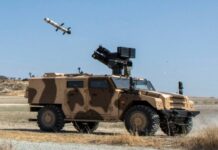


![French drivetrain specialist Texelis is currently working with the French MoD to deliver a HED-powered prototype of the VBMR-L Serval 4×4. [Texelis/KNDS France]](https://euro-sd.com/wp-content/uploads/2026/01/Cover-pic_-Serval-Texelis_KNDS-France-Kopie.jpg "Cover pic_ Serval (Texelis_KNDS France) Kopie")

Despite so much promise, hybrid electric drive technology is yet to be fully embraced by military forces, but perhaps now its time in the limelight is approaching.
Hybrid electric drive (HED) technology, whereby powering a vehicle typically combines an internal combustion engine (normally diesel) with electrical power, is hardly new. In fact, the 81.3 tonne TOG II heavy tank, the heaviest armoured vehicle in the UK’s Tank Museum, which was propelled using a Paxman-Ricardo 12-cylinder diesel-electric engine mated to two electric motor transmissions, was developed in 1940 (although this was not, of course, HED technology in the modern sense and the TOG II could not be propelled by electrical power alone).
In the 21st Century, while HED has been explored in numerous programmes by Western defence manufacturers and is widely used in civilian municipal vehicles, the technology still remains on the cusp of adoption in the military arena, even as the commercial car market increasingly adopts both HED and purely electric vehicles as Western governments chase a greener future with lower carbon emissions.
The advantages of HED
While major ground platforms propelled purely electrically are not an option for armed forces – there being no electrical hook-up points on the battlefield – HED technology, on the other hand, can take full advantage of the current military logistics train for getting diesel and petrol where it needs to be.
Moreover, the tactical advantages afforded by HED have long been recognised: silent running on electrical power alone reduces heat and noise signature; silent watch capability allows an AFV to conduct reconnaissance operations using all of its systems with minimal signature; individually driven wheels enhance tactical mobility; and the plethora of incoming power-hungry AFV systems can be accommodated. Further to this, the burgeoning use of handheld individual soldier systems – from command and control (C2)/situational awareness systems to controllers for unmanned air and ground vehicles – can be readily charged in the field by HED-powered tactical vehicles.
That said, brakes still remain on the adoption of HED. While the technology has constantly matured in the civil arena, there are still questions regarding its military adoption on a wide scale on significant battlefield land platforms. Retrofitting legacy military platforms with HED technology is liable to be expensive, meaning that only introducing whole HED-powered fleets is likely to be cost effective. There is also a training/logistics angle with the need to equip army motor pools with the training and resources required to support such new technology. Meanwhile, questions remain over whether HED technology is truly ‘soldier and mud proof’. Thus far, these issues have conspired to the effect that HED technology – despite its clear advantages – has so far remained beyond the horizon for real military prime time. With incremental moves, however, that situation might finally be changing.
Early endeavours
One of the first efforts in recent decades to embrace HED technology was mounted by BAE Systems Hägglunds in Sweden. Under a contract from the Swedish Defence Materiel Administration (FMV) for the Splitterskyddad enhetsplattform (SEP) programme, BAE Systems Hägglunds produced a tracked demonstrator in 2000, a 6×6 version in 2003 and an 8×8 variant in 2007.
![An early modern foray into HED-powered armoured vehicles was BAE Systems Hägglunds’ Splitterskyddad enhetsplattform (SEP) programme (8×8 variant shown). However, having accumulated no international partners for the project, the Swedish FMV cancelled it in 2008 and BAE shuttered its SEP work the following year. [BAE Systems Hägglunds]](https://euro-sd.com/wp-content/uploads/2026/01/1_SEP-8x8-BAE-Systems-Hagglunds-Kopie-1024x683.jpg)
However, having accumulated no international partners for the SEP programme, the FMV cancelled it in 2008 and BAE shuttered its work on the project the following year, repurposing its HED technology for civilian projects such as a pushback tractor for the A380 airliner, a mining truck and a cargo crane.
Asked by ESD about its ongoing HED initiatives, BAE Systems Hägglunds noted on 1 December 2025 that it has continuously invested in HED technology since the SEP programme, with investments in both the commercial and military realm.
“The military customers’ interest in adopting electric drive technology is definitely increasing and BAE Systems Hägglunds is ready to deliver,” stated a company spokesperson. “The Sirius programme, running with Luleå Technical University, is one public example. Sirius is an annual reoccurring programme, training students in programme management, with the goal to design and test a hybrid electric drive for the Bv206 [tracked all-terrain vehicle]”.
The Bradley HED programme and XM30
Meanwhile, BAE Systems in the United States won a USD32 million contract in July 2020 to integrate HED technology into two M2A2 Bradley infantry fighting vehicle (IFV) testbeds. The deal was awarded by the US Army’s Rapid Capabilities and Critical Technologies Office (RCCTO), working closely with Program Executive Office Ground Combat Systems (PEO GCS) on the effort, with defence technology house QinetiQ also involved as a partner in the programme.
The first vehicle was scheduled start its initial contractor testing at the end of January 2022, with the more formal programme testing with the US Army beginning in March 2022. By June 2022, the Bradley HED vehicles were set to begin assessments at Aberdeen Proving Ground, Maryland, before moving on to Yuma Proving Ground, Arizona, for additional field assessments.
Over the last couple of years the Bradley HED programme went somewhat quiet, however, but the Bradley IFV’s replacement, the XM30 Mechanized Infantry Combat Vehicle (MICV) – formerly known as the Optionally Manned Fighting Vehicle (OMFV) – is slated to have a HED system. In June 2025 the two remaining contenders for this programme – General Dynamics Land Systems (GDLS) with a clean-sheet XM30 prototype (currently lacking a publicly-available designation) and American Rheinmetall Vehicles (ARV) with a modified variant of the KF41 Lynx IFV – passed the programme’s critical design review and advanced into the competition’s prototyping phase.
![To replace to US Army’s Bradley IFVs under the XM30 Mechanized Infantry Combat Vehicle (MICV) programme, American Rheinmetall Vehicles is proposing a modified variant of the KF41 Lynx IFV featuring an Allison eGen Force HED transmission. [American Rheinmetall]](https://euro-sd.com/wp-content/uploads/2026/01/2_XM30-Lynx-American-Rheinmetall-Kopie-1024x576.jpg)
The prototype build and test phase for the XM30 programme began in June 2025 and runs until mid-2027. Production and fielding, beginning with down-select to a single vendor and approval of low-rate initial production (LRIP), is slated for late 2027. A full-rate production decision is expected by FY 2030, with initial operational capability for the M30 expected in FY 2032.
Cracking a difficult nut: Heavy AFVs
In February 2022 the head of mobility for Anglo-German joint venture Rheinmetall BAE Systems Ltd (RBSL), Marcus Potter, told this author that the company had decided to grasp the nettle of providing a HED solution for MBT-sized armoured vehicles.
“The reason we went for the heaviest-weight vehicle,” Potter said at the time, “was because that presented the greatest challenge. Our understanding was that if we could implement a system on that vehicle, then it made all other vehicles relatively easy in comparison.”
On 2 December 2025 ESD caught up with Potter to see how things had developed. “We’ve been investing in HED technologies for a long while now, as I’m sure a few other companies have, and we’ve now ramped up some of the concept work we’re doing,” said Potter. “We’re certainly now looking a lot more serious from the studies in the past, and having discussions with suppliers at conferences, to now actually looking to get proposals from suppliers so that we can have a look at what various suppliers have to offer.”
Potter noted, however, that any HED solution has to compete against traditional, mature mechanical solutions. Regarding the maturity of HED technology, Potter said, “In the commercial and automotive sectors, the TRL levels of the actual individual components are very high; we’re into technology readiness levels of eight or nine; however, in a military environment they’re fairly low in maturity.” He added, though, “I think a lot of the commercial hardware is very applicable to use in the defence environment; the component count is significantly reduced and the actual devices themselves are very robust. So there has been testing of certain systems that have been tested in deep wading environments and shown that they work perfectly well in those environments.”
Potter noted that HED systems in military vehicles would already be afforded a good degree of protection, while their environmental conditioning has already been tested to a high standard level in adjacent industries. Cost, however, remains a significant challenge, both in terms of the programmatic cost for introducing a HED system and the through-life costs of maintaining it.
“What we’re looking at – and this has been a major focus of our investigation over the past years – is how can we get those costs where they’re competitive or even lower than the current mechanical systems,” said Potter. “That’s what we’ve been heavily investing in over the past few years, so that we can aim towards getting every single advantage for the hybrid drive. Current figures are showing that that is very much a case where we can get a competitive system that is at least similar, if not lower, in total through-life cost than the current mechanical systems; that is probably our top priority.”
Potter also noted that power density is an important factor in implementing HED technology: “What we’ve seen, certainly over about the last 10 to 15 years, is that, where 15 years ago we were talking about power densities for the motors somewhere between one and two kW per kilogramme, nowadays the latest figure I’ve been looking at is something as high as 59 kW per kilogramme; we’re talking about 30 times higher than it was 10 to 15 years ago. So those power densities really feed into saying, ‘Well, 15 years ago it was not really feasible to power a main battle tank using the electric motors; you had to go for a fairly unique transmission layout to be able to power that.’ Fortunately now, with that increase in power, that suddenly brings us into the realms of saying, ‘Well, actually, we can power it just using the electric motors.’ So there’s certain aspects that have really changed in the EV market that, keeping a track on the advancements in that market, have allowed it now to start to feed into the military area.”
![An RBSL schematic showing a HED concept for a British Challenger 2 MBT. [RBSL]](https://euro-sd.com/wp-content/uploads/2026/01/3_Tank-diagram-RBSL-Kopie.jpg)
“Obviously, with a retrofit you’re looking to replace the current powerpack and effectively save through-life cost to the end of the programme,” Potter noted. “Now that is a very ambitious target, probably even more ambitious than a new vehicle, but that’s one of the things we’ve been looking at,” he said, stressing that HED solutions “have got to be cost competitive”.
The power output of the latest HED systems is a significant plus point, especially in relation to feeding electrical power so other systems in the field. Potter noted that, while current military auxiliary power generators can deliver up to about 30 kW of power, HED systems, depending on their architecture, could deliver “something like 300 kW all the way up to well over 1500 kW of power”: a capability he cited as “game changer”.
While Potter conceded it remained debatable as whether such power levels would be required in the future, the advent of battlefield systems such as laser-based counter-unmanned aerial vehicle systems would suggest that they are.
Potter also emphasised that systems integration is a vital factor. “That’s where the likes of RBSL come to the forefront and really enable these solutions to happen,” he said, noting that how HED technology can be seamlessly integrated into an existing platform is key to making it a reality. For this, he said, you really need to build something.
“We would always start off with the CAD/CAM side of things. We’d look at the various new manufacturing technologies that that are available, so we can get the best, optimum integration of that system into the platform,” said Potter, “but nothing beats hands-on being able to see that into a vehicle, and nothing beats seeing the vehicle in operation as well. Some of the performance figures we we’re talking about could blow minds. It’s so special in terms of where we could be really driving the performance of these vehicles into a new regime.”
Tactical military vehicles
At the easier end of the ground platform spectrum – tactical military vehicles – numerous developments from Western manufacturers have emerged in recent years, with French companies very much at the forefront of this effort.
The first foray into HED technology by French military vehicle manufacturer Arquus was in 2016 when the company presented the VAB Electer: a HED-powered variant of the French Véhicule de l’Avant Blindé (VAB) 6×6 armoured personnel carrier (APC).
![The Scarabee tactical 4×4, which was soft-launched in 2018 and officially presented in 2021, has been billed by Arquus as the “very first modern hybrid-drive armoured vehicle”, but no sales of the vehicle have been secured thus far. [Arquus]](https://euro-sd.com/wp-content/uploads/2026/01/4_Scarabee-Arquus-Kopie-1024x683.jpg)
Arquus has also worked on a HED-powered version of the Véhicule Blindé Multi-Rôle (VBMR) Griffon 6×6 APC developed and manufactured by KNDS France (formerly Nexter Systems): the main successor to the VAB.
A key French company in relation to the future of HED technology is powertrain specialist Texelis. Working in conjunction with Nexter/KNDS France to produce the VBMR-L Serval 4×4 that began entering service in 2022, Texelis is responsible for all of the Serval 4×4’s below-the-hull automotive systems, including powertrain, driveline and the electric architecture of the mobility system. Crucially, when Texelis designed these systems, realising that the vehicle would probably be in service for the next 30 to 40 years, it ensured that the vehicle was effectively ‘HED ready’. Texelis subsequently approached the French Ministry of Defence (MoD) to propose a pilot programme to implement HED technology into the Serval and this effort began in in May 2024.
![French drivetrain specialist Texelis is currently working with the French MoD to deliver a HED-powered prototype of the VBMR-L Serval 4×4. [Texelis/KNDS France]](https://euro-sd.com/wp-content/uploads/2026/01/5_Serval-Texelis_KNDS-France-Kopie-1024x683.jpg)
As Lydia Zebian, deputy director of Texelis Defense and director of programmes at Texelis, explained to ESD on 5 December 2025, the initial phase of the pilot HED-powered Serval project – to determine the potential of the concept – has now been concluded. The first objective of this looked at feeding all of the potential future energy-hungry payloads, while a second objective was logistics optimisation: providing a 30% increase in range and thus reducing the logistics chain requirements of keeping tactical vehicles supplied with fuel.
“There’s also less maintenance, Zebian noted, “because, for example, the braking system is fully encapsulated into the hub drive unit and so protected from the external environment. And moreover, with the regeneration of braking energy you use the brakes less, the pads have less maintenance, almost no maintenance. You have fewer mechanical parts: no transmission, no drive shafts, no prop shafts, no oil in the differential, no oil in the gearbox because there’s no longer a gearbox, so then you have much less maintenance.”
While Texelis started out with HED components provided by QinetiQ, the company has now developed its own. “We started from a QinetiQ concept because they had 20 years of research behind this and different design evolutions,” Zebian explained. “However, it was not finished; a few technical problems needed to be solved and it could not be industrialised. So we started from that point, but our strength at Texelis is to improve concepts and make them possible in a production line; this is our core business. We are not only design company; we make products. So to industrialise such a good idea was our interest, and that’s why the partnership with QinetiQ worked very well.”
The next phase in the Serval project is to develop a HED-powered vehicle. “The French MoD wanted to explore each benefit of the technology up to the maximum,” said Zebian. He continued, “now that the potential is known, the next phase is about limiting vehicle specification to be optimised at the correct level, so we are concentrating the need on real practical benefits, maximising only three or four criteria and not playing for 10 or 15 criteria. So that’s what we’re doing now, with the objective of developing and outputting a real prototype with these key specifications.”
Texelis first intends to develop a demonstrator vehicle to showcase the most critical aspects of the project. As usual with new technology, this will then be matured and tested further before a prototype is handed over to the French armed forces, which will then conduct their own testing. A prototype should be available in less than three years’ time, although Texelis intends to show a lot more at the Eurosatory exhibition in Paris in June 2026.
Zebian said that the HED technology being produced for the Serval could equally be applied to numerous other vehicles, including heavy armoured vehicles, to deliver advantages such as silent drive, accommodating power-hungry payloads and to enhance the capacity for such vehicle to be subsequently robotised.
HED technology, noted Zebian, “makes the robotisation easy because you pilot everything independently. Each wheel is directly piloted by its wheel station controller and you can imagine very easily how to drive this vehicle without any driver inside. That’s the next step.”
Zebian added that Texelis is additionally working on a HED project related to an 8×8 armoured vehicle. “An 8×8 could be approached, say, in three years if it’s a standard vehicle with drivers inside.” A fully robotised vehicle with an HDU-based mobility system, she added, could be approached in seven or eight years.
![A Texelis HED system hub drive unit. To the left is where the wheel would be attached; to the right is a control/energy panel that could be placed anywhere inside the vehicle. [Texelis]](https://euro-sd.com/wp-content/uploads/2026/01/6_HDU-Texelis-Kopie-1024x724.jpg)
In a final point Zebian argued for the efficacy of serial HED systems, as used by Texelis, as opposed to parallel HED systems that retain the traditional gearbox and mechanical transmission drive of a traditionally powered vehicle in additional to an electrical powerplant.
“The parallel hybrid concept is not bringing too much added value for defence, at least compared to a serial hybrid, because you add the constraints of the conventional driving and the constraints of hybrid technology; you add mass with the parallel hybrid,” Zebian explained. “The parallel hybrid for some people is just reassuring. They don’t get rid of the mechanical systems so they are less afraid about the new technology, [but] when you compare with conventional mobility, if you have a problem on your traditional engine then the vehicle cannot move anymore. In the electrical propulsion concept we propose, if you have one wheel where the electrical engine has a problem, you have three other wheels, or seven other wheels, that can still move on.”
In the United States, as the original provider of the Joint Light Tactical Vehicle (JLTV) to the US military and others, Oshkosh Defense unveiled the HED-powered eJLTV in January 2022. This vehicle improved the standard JLTV’s fuel economy by more than 20%, provided battery capacity of 30 kWh with opportunity for growth, and eliminated the need for a towed generator by providing export power capacity of up to 115 kW.
AM General, having sourced HED technology from QinetiQ through a partnership announced in November 2021, unveiled at the Association of the US Army (AUSA) show in Washington, DC, in October 2023 the Humvee Charge hybrid electric vehicle (HEV) concept: a plug-in HEV variant of the ubiquitous Humvee tactical military vehicle. This features three drive modes – internal combustion engine (ICE) only, a hybrid ICE and electric power mode, and purely electric drive – and offers significant improvements in vehicle acceleration through the combined use of the ICE and electric motor while also offering improvements in range and fuel efficiency.
Additionally, having taken over production of the JLTV from Oshkosh Defense through a competitive contract awarded by the US Army in February 2023, AM General also showcased its JLTV A2 model at AUSA 2023 featuring an upgraded powertrain with a simplified electrical architecture designed to accommodate future hybridisation.
At the AUSA exhibition in October 2024, GM Defense unveiled its Next Generation Tactical Vehicle-Hybrid (NGTV-H) prototype. Based on the Chevrolet Silverado 3500HD ZR2 truck, the Next Gen combines GM’s 2.8L Duramax turbo-diesel engine with a 12-module battery pack capable of storing approximately 300 kWh of power in addition to drive motors for the front and rear axles.
With its total energy output of 300 kWh, the NGTV-H can support several days of silent watch operations and between 145-209 km (90-130 miles) of silent drive, depending on road conditions (off- or on-road), weather and speed. Using both sources of power on the vehicle, GM Defense anticipates it has a range of around 483 km (300 miles), given that the diesel engine can recharge the batteries twice. The battery can go from a 20% to 80% charge in under an hour. This vehicle was tested by the US Army’s 10th Mountain Division during the ‘Combined Resolve’ exercise in Bavaria, Germany, in early 2025.
Meanwhile, in the last quarter of 2024, GM Defense completed the first prototypes of a hybrid variant of its Infantry Squad Vehicle – Heavy (ISV-Heavy). Based on the Chevrolet Colorado mid-size pickup truck, the ISV-Heavy is a heavy-duty truck that uses the same turbo-diesel as the baseline ISV, but the hybrid variant is equipped with a 100 kWh battery bank for silent operations and to supply electrical energy on the battlefield.
![A hybrid-powered GM Defense ISV-Heavy being trialled by the 25th Infantry Division’s 3rd Mobile Brigade in Hawaii in October 2025 as part of the US Army’s Transformation in Contact effort. [GM Defense]](https://euro-sd.com/wp-content/uploads/2026/01/7_ISV-Heavy-GM-Defense-Kopie-1024x768.jpg)
The central objective of hybrid ISV-Heavy vehicles participating in the JPMRC rotation was to facilitate a crucial feedback loop, providing both the US Army and GM Defense with invaluable insights into the future of military mobility. The participation sought to test the hybrid ISV-Heavy in challenging, realistic operational environments to quickly identify areas for refinement and to ensure the platform delivers maximum warfighting capability. It also provided the 25th Infantry Division with access to next-generation commercial off-the-shelf (COTS) technology, informing how best to modernise the force.
“Participating in training exercises like the ones at JPMRC are essential to the GM Defense model, reinforcing our commitment to co-development with our military customers,” a GM Defense spokesperson told ESD on 8 December 2025. “The real-time feedback gathered from soldiers using the vehicles in the field directly informs our engineering, research, and development process, ensuring our products meet the demands of the warfighter.”
In Switzerland, where General Dynamics European Land Systems – Mowag (GDELS-Mowag) has been developing hybrid concepts for its Eagle 4×4 patrol vehicles in recent years, an Eagle V Hybrid technology demonstrator was presented at the company’s test grounds in Bürglen in July 2025.
Just like the conventionally-powered Eagle V, this vehicle has a 210 kW six-cylinder diesel engine, but also features a 370 kW electric drive (two electric motors each developing 185 kW) and a 56 kWh battery. The vehicle thus has a peak power output of 680 kW, allowing the 8.5-tonne Eagle V Hybrid to accelerate from 0 to 50 km/h in 4.1 seconds. In ‘silent drive’ mode, which uses battery power alone, this vehicle has a road range of 45 km.
Further afield, in South Korea, Hanwha Aerospace has also been developing multiple HED-related technologies. In response to questions about these, Daewon Kim, senior manager of IFV business development within Hanwha Aerospace’s Land Systems Business Team 2, outlined two specific projects to ESD on 4 December 2025. The first project, funded by the Korea Research Institute for Defense Technology Planning and Advancement (KRIT), relates to cross-power flow topology and control architecture and in relation to the development of HED transmission and control technology capable of propelling a 25 tonne tracked vehicle. With joint funding from Hanwha Aerospace this is to be installed on a heavy unmanned ground vehicle, with performance verification planned.
The second project is development of a HED propulsion system for Hanwha Aerospace’s Tigon wheeled APC in an effort jointly funded by KRIT and Hanwha Aerospace, although Kim noted that “the e-TIGON development programme is in its early stages and detailed requirements are still being finalised”.
Kim additionally noted that “a prototype capable of demonstrating a hybrid electric propulsion system for a 25 tonne tracked vehicle has been completed and we anticipate unveiling it at various exhibitions starting in 2026.”
“We plan to gradually advance the development programme from a diesel-hybrid to a full-EV combat vehicle,” Kim added. “This will be related to technological advancements in power sources and once technologies such as batteries and hydrogen fuel cells mature to a level suitable for weapon systems. We will have interfaces ready for immediate application.”
The UK’s TD6 project
In 2018 the British Army initiated the Technology Demonstrator 6 (TD 6) project to experiment with HED technologies on three in-service platforms: a Jackal 2 4×4 high-mobility patrol vehicle, a Foxhound 4×4 protected patrol vehicle and a MAN HX60 4×4 6 tonne tactical truck.
Initially tested at UTAC’s site at Millbrook, Bedfordshire, in 2022 the vehicles moved on to the British Army’s Armoured Trials and Development Unit at Bovington in Dorset, where more battlefield-relevant missions were rehearsed and the vehicles’ performance compared against their conventionally powered counterparts.
![A HED-powered Jackal 2 4×4 high-mobility patrol vehicle and Foxhound 4×4 protected patrol vehicle on display at the DSEI defence exhibition in London in September 2021. Along with a HED-powered MAN HX60 4×4 6-tonne tactical truck, these vehicles were the focus of the British Army’s TD 6 project to experiment with HED technology on in-service platforms. [P Felstead]](https://euro-sd.com/wp-content/uploads/2026/01/8_Jackal-and-Foxhound-P-Felstead-Kopie-1024x768.jpg)
The spokesperson further noted that in 2024 the British Army “invested GBP 14 million [EUR 16 million] in battlefield electrification, with a further GBP 13 million programmed, which will inform hybrid-electric requirements for future capabilities.
“Electrification is one of five Army Futures Research and Experimentation strategies directing the technology-driven transformation of the army,” the spokesperson added. “The army has conducted a number of power/energy R&D activities, including smart microgrids and advanced energy storage. These technologies are on a pathway to exploitation within the future equipment programme and advance the army’s thinking around operational energy.”
Immediate requirements
On 13 November 2025 GM Defense, as part of Team LionStrike (also comprising NP Aerospace and BAE Systems), demonstrated its vehicle contenders for two key procurement initiatives under the UK MoD’s upcoming Land Mobility Programme (LMP) – the General Support Utility Platform (GSUP) requirement and the Light Mobility Vehicle (LMV) requirement – to replace the British Army’s fleet of various Land Rover and Pinzgauer wheeled tactical vehicles. The vehicles presented were a GSUP solution based on the Chevrolet S10 Work Truck, the Silverado 1500 ZR2 and the Infantry Squad Vehicle – Utility (ISV-U).
Asked by ESD at that event if the British Army had shown an interest in including a HED capability in its future LMP fleet, JD Johnson, GM Defense’s vice president for global solutions and strategy, said that, although a request for proposals was yet to emerge, the British Army had not thus far expressed any HED-related requirements.
At that event Bradley L Watters, vice president for international sales within GM Defense’s Government Solutions & Strategy division, told ESD of the British Army, “They know they want the technology, but for now they need to get through replacing the Land Rovers and Pinzgauers.”
On the cusp
The aforementioned projects are not a comprehensive list of HED- and hybrid-powered initiatives regarding military vehicles, but their number attests to the fact that the technology is being increasingly developed and trialled. While the advantages of HED technology have been apparent for decades, the brakes on its adoption – such as the limits of battery technology and the maturity of HED components in a military environment – are increasingly dissipating. However, it is perhaps the burgeoning number of power-requiring platform-based systems on the battlefield – such as high-power radios, IED jammers, battle management systems (BMSs), sensors, remote weapon stations (RWSs) and counter-unmanned aerial vehicle (C-UAV) systems including power-hungry high-power microwave (HPM) and high-energy laser (HEL) weapons – as well as the need to off-port energy to other soldier-based applications, such as unmanned air and ground vehicle controllers, radios and situational awareness systems, that could ultimately push HED technology over the edge into true battlefield adoption.
Peter Felstead