


Hans Uwe Mergener

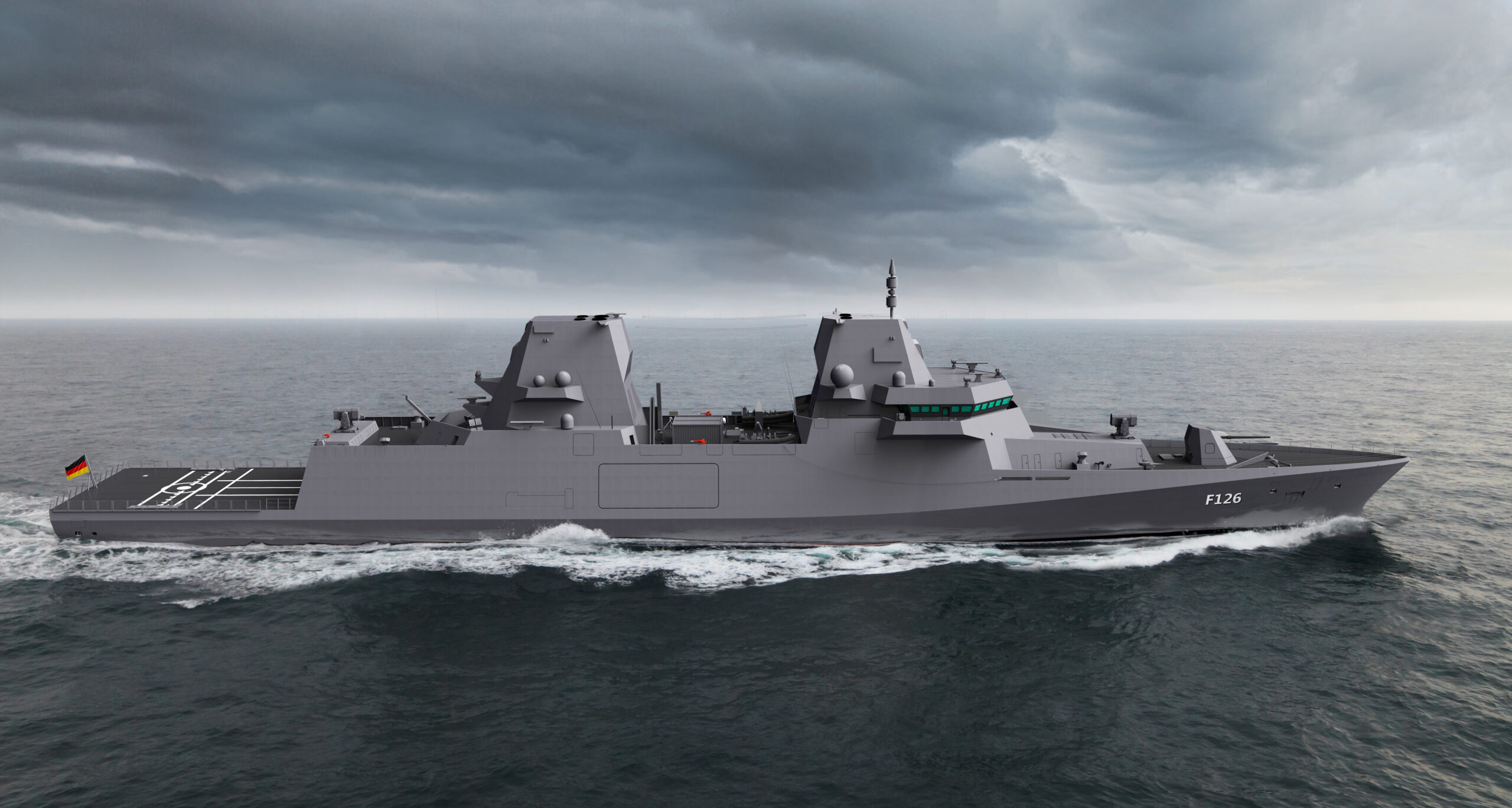
On 28 January 2026 events in German naval procurement intensified: Naval Vessels Lürssen (NVL) announced a technical milestone in the F126 programme, while the Bundestag laid the budgetary foundations for an alternative procurement with the MEKO A-200. This dual development heralds a new reality: the German Navy is pursuing a two-pronged approach.
Technically, NVL was able to overcome a critical bottleneck in the F126 project and transfer all design data from the original main contractor, Damen, to its own systems. This closes the central interface between design and production, paving the way for NVL to assume overall responsibility, which will enable production to continue and ramp up. Section assembly in Kiel, ramped-up pipe production at Blohm+Voss and announced progress in steel shipbuilding in Wolgast are intended to underpin this claim.
The step is technically relevant. With the data transfer, NVL is removing a structural obstacle. Now the F126 programme can be managed operationally. The lack of consistency between design and German manufacturing had blocked the project.
At the same time the Bundestag responded to the time pressure. On the same day the Budget Committee approved a preliminary agreement with ThyssenKrupp Marine Systems (TKMS) for the procurement of MEKO A-200-class frigates. To this end, EUR 50 million was released to secure production slots and order materials with long delivery times. The aim is to have the first ship ready for delivery by the end of 2029. In addition, two restrictions imposed on the defence budget in connection with the F126 project were lifted. The political signal is clear: a technical fresh start is feasible. German Defence Minister Boris Pistorius is reported to have said, “We are not giving up on the F126, but we want to pursue a two-pronged approach.”
Critical factor: time
However, the progress made in the transfer of F126 design data does little to change the fundamental issue of the F126 programme being significantly behind schedule. For the navy, which urgently needs to renew its capabilities, particularly in anti-submarine warfare (ASW) in the North Atlantic, it is the security situation that sets the pace – not the industrial catch-up process.
Parliament had already prepared for this, with the Bundestag creating budgetary leeway for an alternative procurement in 2025. The MEKO-A200 platform under discussion serves as a realistic reference: faster availability, industrially manageable and with lower development risk.
Parallelism as an opportunity and a test
The simultaneous stabilisation of the F126 programme and the acceleration of an alternative procurement show that Germany is capable of finding innovative solutions to old procurement problems. The dual strategy may be costly and complex, but in view of the security situation it is a clear commitment: the navy should receive its new frigates as quickly as possible – if necessary in two ways at once.
Cancelling the F126 programme would be politically and financially difficult to justify. According to our calculations, around EUR 1.8 billion has already been invested, capabilities planned and industrial commitments made. Suppliers are continuing to fulfil their contractual obligations. The course that has been set – a technical restart while preparing an alternative solution – is rationally justifiable, despite its fragility.
A parallel approach makes it possible to work simultaneously on the complex F126 and on units that are available more quickly. Thanks to the MEKO-A200, new ships could be delivered again from 2029, according to a Reuters report on 21 January 2026, shortening the gap to the delivery of the F126. However, even if NVL is taken over, there remain incalculable risks of delays and cost overruns. If the plug were to be pulled, the MEKOs would remain the only new class of German frigates.
The schedule is ambitious but, provided no further technical obstacles arise, it is feasible. It will be important that the contracts are actually concluded in 2026 – both the restructuring with NVL/Damen and the MEKO purchase. Any further delay on paper would diminish the advantage of the parallel course. According to the information available to us, an offer from NVL is expected by 30 April. This means that a final decision could be available by mid-May or, at the latest, by the end of May. The extent to which this will then be dealt with in parliament cannot be estimated at this stage.
Realism of a parallel strategy and critical points
The coexistence of the F126 and MEKO A200 – flanked by the upcoming F127 programme – poses a considerable organisational challenge. Three major surface combatant projects are accessing limited resources in parallel: design, shipyard capacities, supply chains and acceptance processes.
Industrial policy is responding to this burden with structural reorganisations. The planned takeover of NVL by Rheinmetall integrates a key naval shipbuilding player into a large defence contractor for the first time, thereby strengthening financial risk-bearing capacity, project management and system responsibility. However, even if this structural consolidation can improve the manageability of complex programmes, it does not create additional slipways, engineers or construction capacity and thus does not solve the core problem of parallel large-scale projects.
Regarding logistics and personnel, introducing two new ship types in parallel means establishing two separate logistics lines. This affects spare parts storage, maintenance and training for crews and technicians. For the navy, this means separate simulators and training for crews for the MEKO and F126. However, different classes are already being operated in parallel today (F123, F124, F125), which is basically manageable. One advantage is that the MEKO technology is based on the F127 design and some of the equipment is identical, meaning that synergies can be created – for example, certain weapon systems and communication systems could be standardised on all future classes.
The shipyard and personnel issues are critical: are there enough engineers, skilled workers and dock space for three programmes (F126, MEKO, F127)? As mentioned above, industrial policy measures (such as Rheinmetall’s takeover of NVL) can create financial and a certain degree of organisational stability. However, they do not create construction capacity – and thus do not solve the core problem of parallel large-scale programmes. There is also speculation in the industry about possible consolidation measures (such as TKMS’s interest in German Naval Yards Kiel), which could bundle capacities in the medium term and possibly also open up new ones. However, no firm decisions have been made on this yet.
In the short term the challenge remains to provide expertise for the demanding F126 continuation and, at the same time, to launch the simpler MEKOs. Priorities may have to be set here if bottlenecks occur. It is difficult to predict who would then be given priority.
In terms of finances, the parallel solution is undoubtedly costly. In addition to the pure procurement costs, there are high additional expenses for parallel operation and duplicate structures in logistics and training. NVL is also likely to require a financial surcharge for taking over the Damen project (keyword: risk premium or additional project funds). However, Germany has basically provided the funds with the special Bundeswehr fund and rising defence budgets. The EUR 7.8 billion reserve for the alternative and approximately EUR 10 billion for F126 are anchored in the financial plan. Nevertheless, the risk of ongoing additional expenditure without tangible results remains. With strict controlling, the parallel path could be financially manageable. Drifting costs could increase political pressure to cut one of the programmes.
Regarding personnel and operations, the navy already currently has personnel problems, while more ships mean more crews. Even if the F126 and MEKO operate with smaller crews (both concepts rely on a high degree of automation), additional specialists will have to be trained. Recruiting young talent will be a limiting factor, regardless of the type of ship.
Conclusion
NVL has delivered with the transfer of the design data. The real test will come in everyday production, under the pressure of the threat situation, in which Germany can hardly afford further delays.
With the public announcement of the data transfer and the release of budget funds, the fundamental political decision to continue the F126 programme has effectively been made. The question is no longer ‘if’, but whether the loss of time can be sufficiently offset by supplementary procurements. The parallel implementation of F126 and MEKO is an ambitious but not unrealistic undertaking. It promises the best of both worlds in terms of time, but requires logistical and financial stamina.
Every option has its price. A pure MEKO plan would deliver results faster, but initially with lower capability (reduced ASW performance compared to the planned F126 with all its extras) and the loss of previous investments. Continuing with the F126 alone offers maximum capability gains, but too late. The parallel plan attempts to combine both – despite the existing risk that one will ultimately fall by the wayside.
Viewed impartially, the navy is facing profound changes: either accelerated fleet renewal with all the pain of parallel systems; or a hard change of course towards a unified but slimmed-down solution. The fact that these alternatives are even being discussed underlines the urgency of the situation. The time for delays is over. The navy needs new ships – whether via an F126 reset, a MEKO bridge or both at the same time. The political maxim is to remain capable of action – even at the cost of double investment. In the reality of the turning point of 2026, this seems to be the price to pay to steer Germany’s navy out of its frigate crisis.