




Following talks at the DSEI Japan defence exhibition, held in Tokyo from 15 to 17 March 2023, the United Kingdom and Japan have signed an agreement to co-operate in space.
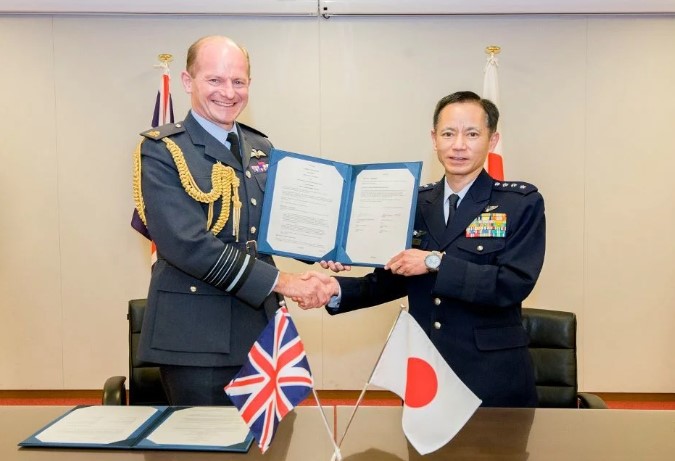
A Terms of Reference document has been signed by the UK’s Chief of the Air Staff, Air Chief Marshal Sir Mike Wigston, and the Chief of Staff of the Japan Air Self Defence Force (JASDF), General Shunji Izutsu, the UK Ministry of defence announced on 17 March.
The arrangement establishes a framework for space engagement talks, which will facilitate future co-operation between the JASDF and UK Space Command. Areas of co-operation will include operational knowledge sharing, collaborative exercises and training, and personnel exchanges. The accord also sets out a mutual desire for the sharing of space-related information through future information-sharing arrangements.
“Japan is a valued international partner of the UK,” ACM Wigston was quoted as saying. “We share common values and strategic interests, and we are working ever more closely in the face of global security challenges. The space domain is critical to our shared security and prosperity, and a vital area of co-operation, underpinned by UK Space Command and the Koku-Jietai [JASDF].”
Air Vice-Marshal Paul Godfrey, Commander of UK Space Command, added that “Our international partners are our greatest advantage in the space domain. This arrangement is an important step as we build our relationship with the JASDF, so that we can keep space safe, secure, and sustainable for the benefit of all.”
UK Space Command is the UK military’s joint lead for space operations and space capability. It is based at RAF High Wycombe and staffed by personnel from the Royal Navy, British Army, and Royal Air Force, alongside civil servants and contractors.
UK and Japanese as well as Italian defence officials also used the opportunity of DSEI Japan to underline their trilateral Global Combat Air Programme (GCAP) publicly for the first time since it was announced on 9 December 2022. A GCAP stand at DSEI Japan was staffed by personnel from all three countries and featured a new 3 m model of the latest illustrative design iteration aircraft as well as a cockpit demonstrator and immersive simulators.
While at DSEI Japan the industry partners involved in GCAP made a number of collaborative agreements:
- BAE Systems, Mitshubishi Heavy Industries (MHI) and Leonardo stated that they continue to work closely together on the next steps in the GCAP effort with a shared ambition for a joint industrial arrangement;
- Rolls-Royce, IHI and Avio Aero set out the terms under which they will pool their expertise to design, manufacture and test a full-scale future combat engine demonstrator;
- Defence electronics firms Mitsubishi Electric, Leonardo UK and Italy’s Leonardo and Elettronica signed a collaboration agreement as “the next formal step towards a permanent industrial construct” focused on delivering GCAP’s Integrated Sensing and Non-Kinetic Effects & Integrated Communications Systems (ISANKE & ICS) domain.
GCAP’s formation in December 2022 merged the UK-led Future Combat Air Systems/Tempest future-generation fighter project, in which Italy was a partner, with Japan’s effort to develop a sixth-generation fighter under its F-X programme.
Peter Felstead

![Serve to lead. Officer Cadets march past the Old College building during their commissioning ceremony, known as Sovereign’s Parade. [Crown Copyright 2013]](https://euro-sd.com/wp-content/uploads/2025/09/S1-Kopie-218x150.jpg "Serve to lead")
![These These images of Tempest studies do not represent an evolution, since several of them were undertaken in parallel. They do represent different emphases on elements of the requirement. The first to be seen was the ‘Pregnant Pelican’, as unveiled at Farnborough in 2018. The Concept Class Five aircraft was unveiled at Farnborough in 2022, while the Lambda-winged aircraft (the P189-17B) was first seen at DSEI Japan the following year. The so-called ‘Big Delta’ was revealed at Farnborough in 2024. [BAE Systems; Ministère des Armées/SITTA]of Tempest studies do not represent an evolution, since several of them were undertaken in parallel. They do represent different emphases on elements of the requirement. The first to be seen was the ‘Pregnant Pelican’, as unveiled at Farnborough in 2018. The Concept Class Five aircraft was unveiled at Farnborough in 2022, while the Lambda-winged aircraft (the P189-17B) was first seen at DSEI Japan the following year. The so-called ‘Big Delta’ was revealed at Farnborough in 2024. [BAE Systems; Ministère des Armées/SITTA]](https://euro-sd.com/wp-content/uploads/2025/09/7D-RS171720_2620-LONDON-24-IMAGE-01-2-Kopie-218x150.jpg "The Combat Air Flying Demonstrator: Rehearsing and preparing for GCAP")
![The UK aircraft carrier HMS Prince of Wales (foreground) sails alongside the US carrier USS George Washington during Australia’s ‘Talisman Sabre’ exercise in July 2025. The two carrier strike groups (CSGs), plus Australian Navy assets, conducted CSG integration activities. [Crown copyright 2025]](https://euro-sd.com/wp-content/uploads/2025/09/1-PWLS-GW-TSabre-CC-UK-MoD-25-Kopie-218x150.jpg "Strategic shift: UK CSG deployment demonstrates switch in UK strategic focus")
