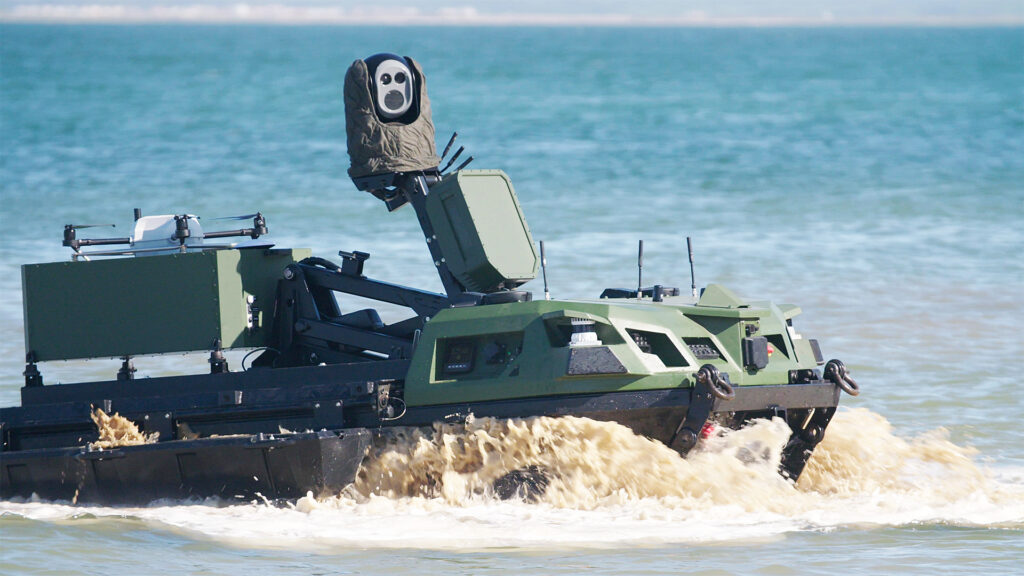



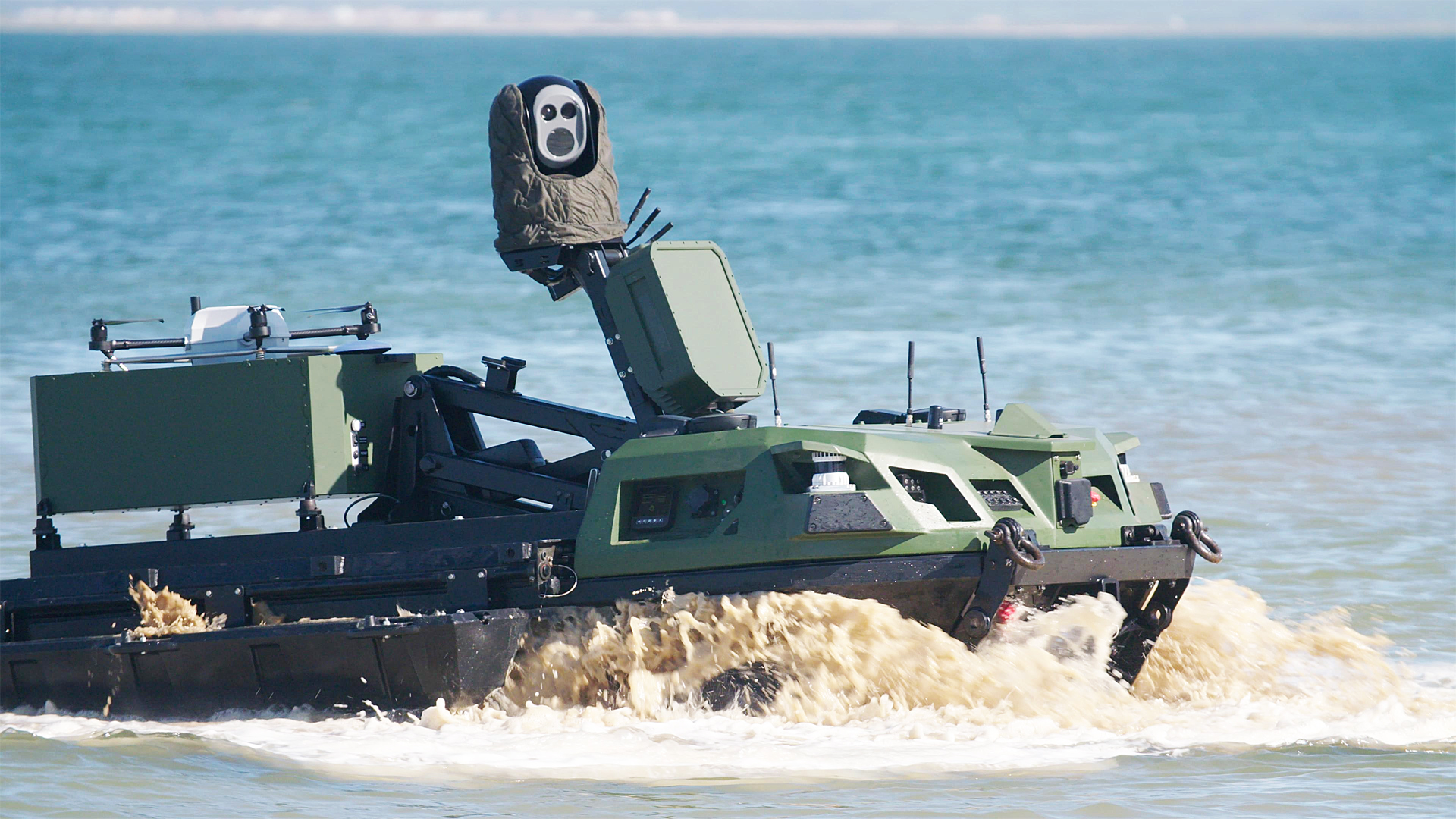

Rheinmetall’s Mission Master SP2 autonomous uncrewed ground vehicle (A-UGV) was deployed in sea-to-land operations during this year’s NATO Robotic Experimentation and Prototyping with Maritime Unmanned Systems (REPMUS)/Dynamic Messenger exercises in Portugal, Rheinmetall announced on 18 November 2025.
The aim of the exercises, held out of Troia and Sesimbra in Portugal throughout most of September, is to promote innovation and improve interoperability in the maritime sector through co-operation between NATO allied armed forces, academic institutions and leading industrial companies. The exercises were organised by the Portuguese Navy, NATO and the European Defence Agency (EDA) and this year featured an added layer of operational exercises.
Operational experiments with Mission Master
The operational experiments provided an opportunity to validate next-generation technologies under mission-relevant conditions. Rheinmetall presented command-and-control systems, advanced sensor technologies and mission management platforms developed for use in complex, multinational operations.
The Mission Master SP2, the LASSy ‘robot dog’ and the PATH Autonomous Kit operating system were all integrated into a harbour defence scenario. The joint actions – including those involving UxVs from other providers – were controlled via Battlesuite: an app store-like shared information space that eliminates data silos and enables quickly integratable, ready-to-use capabilities, according to Rheinmetall.
The electrically powered Mission Master was equipped with buoyancy devices on both sides for sea-to-land operations. A sensor mast with electro-optical (EO) cameras, a radar and a tethered drone from Elistair were installed for reconnaissance purposes. For the reconnaissance mission as part of 360° port and coastal protection, the Mission Master was launched and carried out its mission autonomously. The degree of autonomy is determined by the PATH kit, which allows for control interventions at any time.
Reliable operation under harsh coastal conditions
According to Rheinmetall, the Mission Master was used in a combination of autonomous navigation, modular payload integration and high adaptability, in addition to conducting reconnaissance, surveillance and logistical support duties. In combination with maritime sensor systems, the unmanned ground system demonstrated its ability to operate reliably and perform well in harsh coastal conditions, as shown in a video provided by Rheinmetall.
“The REPMUS exercise provided an excellent opportunity to test the interaction of ground- and air-based unmanned systems in a demanding NATO environment,” stated Gregor Mannherz, sales manager for marine systems at Rheinmetall Electronics. “Mission Master and Luna NG [a Rheinmetall UAV] have impressively demonstrated how technology and integration can effectively support our defence partners.”