



Hans-Uwe Mergener

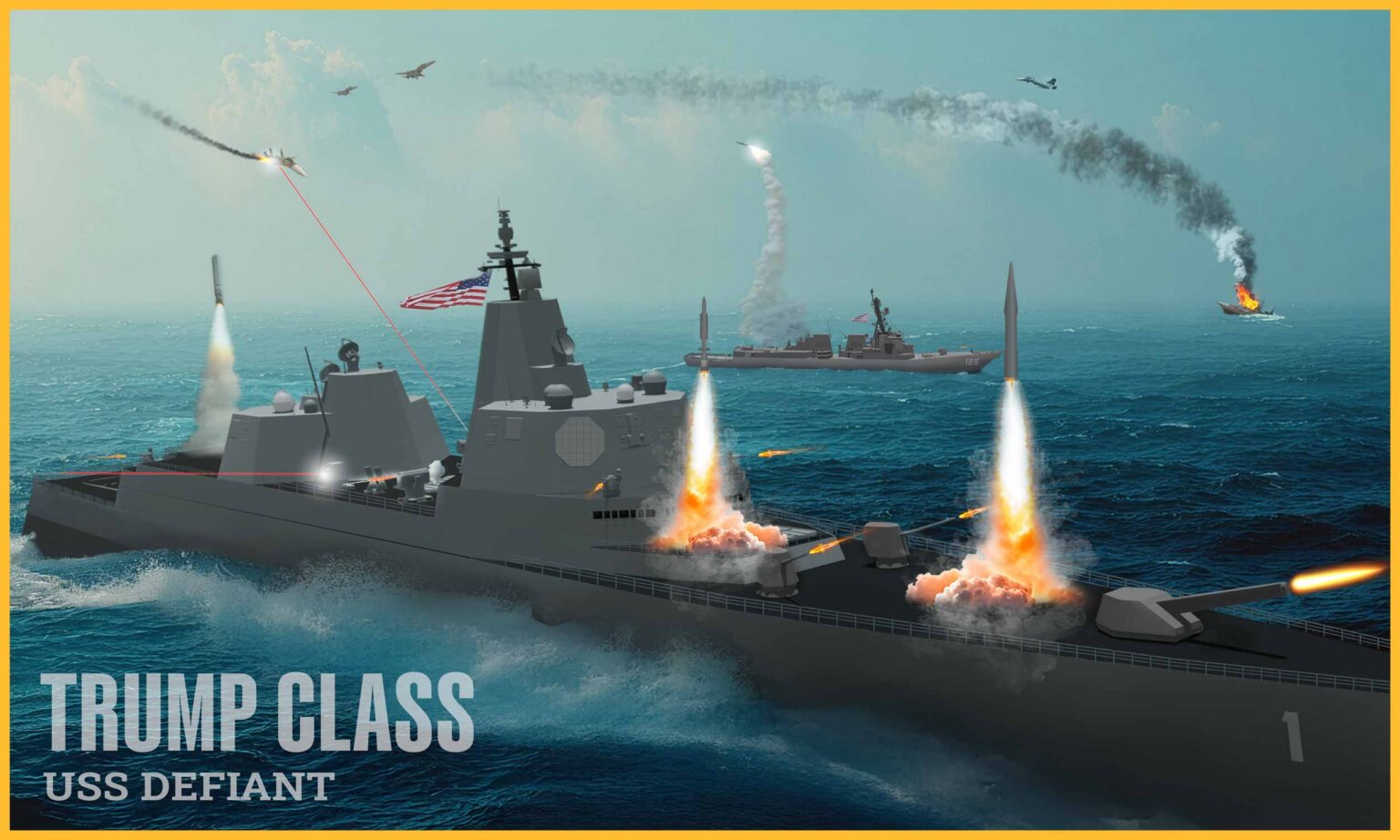
On 21 December 2025 the US government announced the introduction of a new class of large surface combatants in a press release on navy.mil: the ‘Trump class’. President Donald Trump followed up on this a day later in a speech at his Mar-a-Lago residence in Florida, presenting the ships as the centrepiece of a ‘Golden Fleet’. USS Defiant (BBG-1) is to be the first ship, with plans for 10–25 units. The goal: to restore visible maritime superiority over China and Russia.
Key technical data and armament
Initial conceptual key points have been published on an accompanying, politically framed information page (‘goldenfleet.navy.mil’). With a displacement of 30,000–40,000 tonnes, the Trump-class units would be larger than Arleigh Burke-class destroyers (9,200 tonnes) and roughly comparable to historic Iowa-class ships (45,000 tonnes fully loaded). The ships will be equipped with 120–130 VLS cells for conventional and potentially nuclear-capable hypersonic weapons (SLCM-N-like concepts), supplemented by railguns, 5-inch gun turrets, high-energy lasers and drone integration. Positioned as the ‘most lethal surface combatant ever,’ they are intended to take on C2 functions for manned/unmanned formations. Propulsion and protection remain vague. The announced nuclear armament would mark a paradigm shift: away from the ‘submarine discretion’ that has dominated since the 1990s toward deliberately visible nuclear deterrence.
Vanity project?
CNN and Reuters estimate the cost at USD 5–7 billion (EUR 4.24-5.93 billion) per unit. Keel laying is projected for 2028/29 at the earliest, with commissioning in 2035+, depending on the FY2027 budget and Congress.
Navy Secretary John Phelan is pushing for open competition among shipyards such as Huntington Ingalls and General Dynamics in order to scale construction cost-effectively and avoid delays such as those experienced with the Littoral Combat Ship and Constellation class. President Trump is sharply criticising defence contractors for chronic cost overruns and production backlogs. He is demanding accountability and threatening penalties.
In contrast, resource competition is emerging in the context of the upcoming portfolio of carriers (Ford CVNX), submarines (Columbia SSBN, Virginia Block V), destroyers (Burke Flight III, DDG(X)), frigates (Constellation FFG(X) successor), the US Marine Corps’ amphibious vehicles and now the Trump class. According to the US Government Accountability Office, shipyards such as HII Newport News, Bath Iron Works, Fincantieri Marinette and General Dynamics National Steel and Shipbuilding Company are finding it increasingly difficult to meet construction schedules. Given the real gaps in the fleet, the Trump class is thus taking on the character of a highly prestigious flagship project.
Operational capability, political availability
Overall, the Trump class represents less a consistent fleet concept than a strategic experiment under increasingly challenging conditions. In presidential communications, it is framed as the building block of a so-called ‘Golden Navy’ – a political narrative that emphasises visible strength without yet providing operational or financial resilience. In fact, the platform combines nuclear deterrence, firepower, air defence and command in a highly visible unit – in a security policy environment that is characterised by interconnectedness, vulnerability and industrial bottlenecks.
Whether this will result in operational substance or primarily a symbolic flagship project will be decided not in announcements, but in the budget, in industry and in operational performance. The first reliable test will be the FY2027 defence budget.
For European NATO member states, the Trump class is above all a textbook example of the growing discrepancy between military capability and political availability. Operationally, such a platform would significantly expand the US spectrum in the areas of air defence, long-range weaponry and command-and-control capabilities at the unit level. However, these capabilities exist independently of the question of whether they would actually be made available in the event of an alliance conflict.
Particularly under a US administration that ties security policy commitments more closely to national interests, the mere existence of military resources does not automatically translate into alliance benefits. For European armed forces, this means that a structural starting point remains: key assets, ammunition, sensors and software continue to originate to a considerable extent from the US. Deterrence within the alliance thus becomes not only a question of military presence, but increasingly a question of political synchronisation.
Beyond the purely maritime dimension, the Trump class also signals a deliberate shift in US sea power projection. The possible deployment of nuclear-capable weapons on surface ships increases their military relevance – but also their target priority and escalation potential in high-intensity peer conflicts. Visibility explicitly becomes part of the deterrence logic here, with correspondingly increased risks.
Industrial policy implications – the case of the F127
There is also an industrial and supply-side dimension. A resource-intensive flagship programme such as the Trump class is likely to tie up considerable development, integration and production capacities in sensor technology, effectors, software and system integration, especially where US approval and update cycles apply. In an already-tense US defence environment, this can lead to prioritisation conflicts that extend beyond national programmes.
This is also relevant for European programmes. Projects such as the German F127 frigate rely on US systems and supply chains in key areas. If capacities are prioritised in favour of the US Navy in the development of the Trump class, this could have indirect effects on schedules, delivery sequences or availability – even if export licences remain in place. Whether this will happen is less a political question than one of industrial practice.



![During RIMPAC 2024, USN crew successfully 3D-printed a replacement part onboard USS Somerset. [US Navy]](https://euro-sd.com/wp-content/uploads/2026/01/LPD-25-USS-Somerset-088-Kopie-218x150.jpg "From logistics to liability: Bridging the ‘trust gap’ in naval 3D printing")