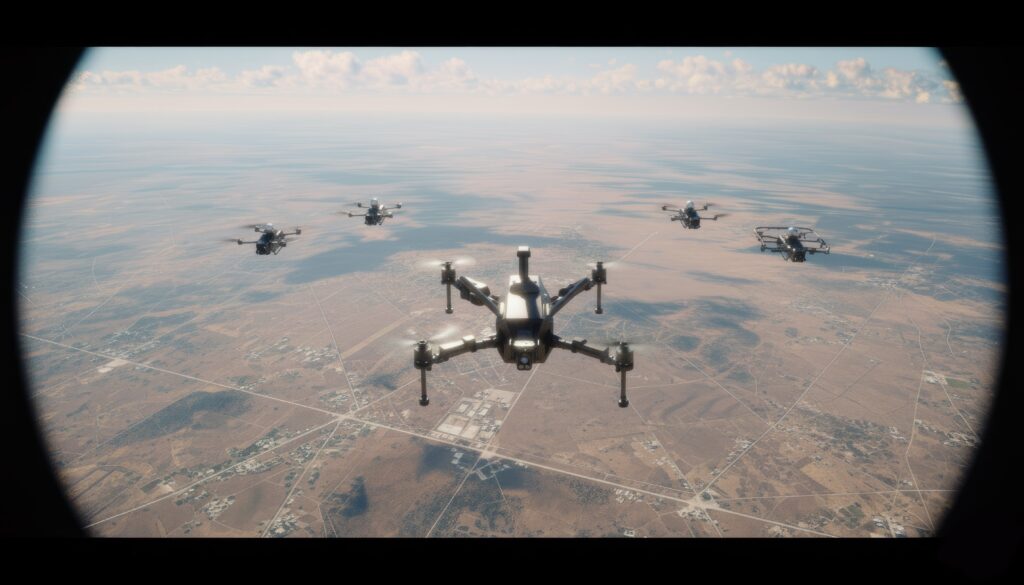





Lockheed Martin’s Skunk Works and drone specialist XTEND have collaborated to integrate the XTEND Operating System (XOS) into Skunk Works’ MDCX autonomy platform, allowing simultaneous command and control (C2) of multiple classes of unmanned aerial system (UAS) and creating improved situational awareness for lower-level mission execution in joint all-domain C2 (JADC2) scenarios, Lockheed Martin announced on 18 December 2025.
In November 2025 the two companies demonstrated an integrated Multi-Class MDCX (MC-MDCX) workstation in support of a marsupial drone mission. In the demonstration a larger class UAS delivered a smaller UAS Class 1 drone to perform a close-in mission. In previous constructs the operator of the larger UAS would pass control over to an operator with lower-level controls for Class 1 or 2 vehicles, which include first-person views, mark-and-fly commands and immersive environments for the drone operator to fully execute the mission. With the planned integration of XTEND’s XOS into Lockheed Martin’s MC-MDCX, a single operator can conduct both missions.
The integration demonstration proved a reduction in total manpower for complex mission executions, removing the need for mission hand-offs to lower-tiered operators and improving situational awareness across the mission space, Lockheed Martin stated.
Lockheed Martin Skunk Works and XTEND are now focused on how these techniques can be applied to JADC2 missions and decision loops for advancing autonomous systems.
“Skunk Works is dedicated to enabling piloted and drone teaming to optimise operational flexibility, abbreviate data-to-decision timelines and improve pilot safety,” Lockheed Martin stated. “We continue to collaborate with and invest in enabling technologies to keep our customers ahead of emerging threats.”