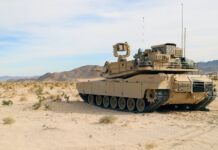


![An upgraded BREM-1M armoured recovery vehicle, featuring a new explosive reactive armour (ERA) layout, anti-drone protection, and electronic warfare jammers. Note the towing coupler attached to the dozer blade, which allows the crew to recover damaged vehicles without leaving their own vehicle. [Alexey Tarasov]](https://euro-sd.com/wp-content/uploads/2026/01/Brem-1M-upgraded-Kopie.jpg "Brem-1M upgraded Kopie")

The mass employment of unmanned aerial vehicles (UAVs) in armed conflicts over the past decade has initiated numerous debates on the current state and future development of armoured vehicles, as well as on the employment of armoured forces – their structure and role on future battlefields. While these debates are far from concluded, the broader discussion has moved away from oversimplified statements, toward more detailed and sober assessments and analysis. The major question, however, remains: How can armoured forces counter the drone threat to heavy armour today?
Controversy and consensus
Before diving into the analysis of this matter, it is important to note that armoured forces and heavy armoured vehicles have proven indispensable in all recent armed conflicts since 2020, despite the changing and increasingly hostile conditions on the battlefield. Armoured forces continue to play a critical role in modern ground warfare, while many militaries across the globe plan to expand and further develop this branch of service. The tank is not dead, and armoured forces are not going to go extinct in the near future.
Undoubtedly, armoured forces and armoured fighting vehicles (AFVs) have to adapt to the new combat environment – technically, tactically, and doctrinally. However, this has been a normal part of their evolution since the beginning of the 20th century.
Moreover, the contemporary ‘drone scare’ – a widespread mindset today – has historical analogues. In the late 1930s, based on an assessment of the experience of the Spanish Civil War, Soviet military leadership concluded that strong anti-tank defences and masses of small-calibre anti-tank artillery had rendered the use of large armoured formations impossible.[1] In the 1960s and 1970s, the proliferation of anti-tank guided missiles (ATGMs) gave rise to the view that heavy armoured vehicles would become obsolete due to the development of guided weapons. In the 2010s, some politicians and military thinkers questioned the value and relevance of the armoured branch, arguing that the geostrategic environment had changed, making “the prospects for another head-on clash of large mechanised land armies seem less likely”, as stated by then-US Secretary of Defense Robert M. Gates in a 25 February 2011 speech at West Point.[2]
Today, proponents of the idea that developments in UAV technology, loitering munitions, and anti-tank weapons have ‘changed the nature of ground combat’, rendering armoured vehicles ineffective and obsolete, largely follow the same path by drawing generalised conclusions based on incomplete, misinterpreted, and difficult-to-verify information.
Against this background, the critical issue is not whether armoured forces remain relevant, but how the drone threat should be correctly assessed in order to distinguish genuine technical and operational challenges from overstated conclusions and to develop comprehensive anti-drone solutions.
Beyond the buzzwords: evaluating the drone threat
For a correct assessment, two key aspects should be examined: the true scale and nature of the threat, and the actual effectiveness of small drones in the anti-tank role. It is important to note, however, that the assessment of these aspects can be challenging for several reasons.
![A T-80BVM tank featuring an array of anti-drone protection measures, including passive barriers, ERA, and electronic warfare jammers. [Alexey Tarasov]](https://euro-sd.com/wp-content/uploads/2026/01/T-80BVM-with-addon-armor-Kopie-1024x768.jpg)
In an interview published in December 2024, Ukrainian drone commander Robert Brovdi (callsign “Madyar”) provided statistics on the effectiveness of FPV drones: “The effectiveness rate across different units varies between 20 and 40 percent. I am not referring to cases in which a drone merely reached the area and produced unclear or unconfirmed effects. Only cases in which the drone reached the target, successfully struck it, and the result was recorded should be included in the statistics.” [3]
In other words, only two to four out of ten drones actually affect the target, in addition to an unknown number that fail to reach it for various reasons, such as weather, electronic or mechanical failures, enemy countermeasures, or piloting errors, to name but a few. Some specialists, however, consider the 20–40% rate to be inflated, suggesting that a more realistic figure may be below 20% even under favourable conditions. Given that the majority of drones used in the anti-tank role in Ukraine rely on commercial components never designed for harsh and unpredictable battlefield conditions, the latter assessment sounds reasonable.
Second, available data indicate that strike UAVs and loitering munitions rarely cause irrecoverable damage to heavy armoured vehicles on their own; rather, it is the combination of multiple assets that does so. In a very typical scenario, a heavy AFV – such as a tank or engineering vehicle – could be damaged or immobilised by ATGMs, artillery fire, or landmines, after which drones finish off the abandoned vehicle. While the vehicle will likely be destroyed eventually, analysing scenarios like this adds little to the question of AFV protection. Even the best-protected vehicle could be destroyed if its electrical system – powering the active protection system or electronic warfare jammers – is disabled, allowing a drone to strike through an open hatch, thereby bypassing passive armour.
Third, there is often no way to determine which asset caused the critical damage by analysing combat footage alone. The most reliable method of assessing the damage remains the examination of the damaged and destroyed AFVs on the ground.
As a result, evaluating the true effectiveness of drones against AFVs, including heavy armoured vehicles, remains difficult. What is more certain is that drones and loitering munitions have added to, rather than replaced, the established array of threats to heavy armour, such as ATGMs, guided artillery munitions, and mines, among others.
Nevertheless, their increasing presence on the battlefield, combined with the pace of their evolution, necessitates adaptation by armoured forces not only in technological terms, but also tactically and doctrinally, in order to counter this evolving challenge.
Solutions at the platform level
The question of countering the drone threat could be split into two major directions: first, the protection of individual armoured vehicles; and second, collective defence of armoured units and formations.
![A Leopard 2A8 at its roll-out ceremony in Munich, on 19 November 2025. The new model, equipped with the Trophy APS, is being produced for the German and Norwegian Armed Forces. [KNDS]](https://euro-sd.com/wp-content/uploads/2026/01/Leopard-2A8-rollout_sm-Kopie-1024x702.jpg)
Overhead/top attack protection. First introduced by the Russian Army in June–August 2021,[4] this type of tank turret protection has evolved and proven its utility. By 2026, it had entered experimentation or seen combat use in more than 20 countries, including China, India, Japan, Poland, France, Israel, and Taiwan, among others. In turn, the US Department of Defense’s budget estimates for Fiscal Year (FY) 2026 include a request to fund the procurement of four Armoured Brigade Combat Team sets of a Top attack protection capability. Top attack protection is described as “a passive add-on armour that is placed over crew compartments and hatches to mitigate damage from overhead threats,” making it highly likely that the US Army has also joined this group.[5]
The design of top-attack protection continues to evolve, with newer variants being introduced into service and tested in combat. Russia, and apparently Ukraine, make widespread use of complex, multi-layered variants incorporating explosive reactive armour (ERA), nets, slat armour, and rubber-polymer screens. Notably, Russian industry has been offering serially-produced top-attack protection for heavy armoured vehicles since at least October 2023. While Ukrainian mechanised forces have also employed standardised variants of top-attack protection, the extent to which these are serially-produced or ad-hoc field upgrades based on a common design remains unclear.
Explosive reactive armour. New configurations have been introduced, with ERA now covering larger areas and is combined with other forms of passive protection, including slat armour, polymer nets, and various types of screens.
Electronic Warfare (EW) jammers. So far, the primary operators of anti-drone electronic countermeasure systems have been Russia and Ukraine. However, other nations have also begun experimenting in this field. In December 2025, it became known that the M1E3 – a prototype of a new main battle tank for the US Army – will likely incorporate an electronic warfare (EW) system intended to jam and/or spoof drone command and/or guidance systems.[6] Meanwhile, Russia and Ukraine continue to improve their EW jammers used with heavy armoured vehicles, expanding their capabilities and the range of frequencies across which these systems are able to disrupt UAVs. An important detail is that Russia’s Uralvagonzavod (UVZ) now includes EW jammers as part of the standard factory-installed package of additional protection for MBTs.[7]
Active Protection Systems (APS). As more countries accept these systems into service and additional integrations enter the market, active protection systems are gradually becoming a ‘must-have’ capability. Notably, a growing number of systems in service and integrations is likely to make APS more affordable, which in turn may stimulate further procurement. In this sense, a ‘democratisation of active protection systems’ is taking place.
The technology is also maturing and adapting to new requirements. In October 2024, Rafael unveiled an upgrade to the Trophy APS, adding the capability to counter some forms of top-attack munitions, including drones.[8] Another APS – Iron Fist by Elbit Systems – continues to evolve and has also been upgraded to counter some forms of UAVs and loitering munition threats, as noted on the developer’s website.[9] The Iron Fist APS has been selected to upgrade the US Army’s Bradley M2A4E1 Infantry Fighting Vehicles (IFVs). In January 2026, the company was awarded USD 150 million in contracts with BAE
![A T-72B3A at UVZ’s trials site. The new modification features a combination of Kontakt-1, Kontakt-5 and Relikt ERA, electronic warfare jammers, anti-drone protection measures such as overhead protection, netting and rubber-polymer screens, along with an upgraded version of the Arena-M APS. [UVZ]](https://euro-sd.com/wp-content/uploads/2026/01/UVZ_1902-Kopie-1024x683.jpg)
Historically, a tank modification receives a new designation only after testing and acceptance trials. This suggests that during 2025, the T-72B3M equipped with an upgraded version of Arena-M was tested – possibly even field-tested in Ukraine – and has now entered serial production. Arena-M is also expected to be integrated with T-90M tanks.
Remote weapon stations (RWSs) with a counter-unmanned aerial vehicle (C-UAV) capability. This is an emerging sector offering flexible and cost-effective solutions based on existing technologies and components. Significant advantages of adding C-UAV capability to remote weapon stations (RWSs) include rapid deployment and a lower cost-per-kill ratio compared to missile systems.
Over the past few years, major manufacturers of RWSs have stepped forward with C-UAV solutions based on their products, including Kongsberg,[12] EOS Defense Systems,[13] and Moog Inc., among others.
Some militaries have begun experimenting with RWS featuring C-UAV capability tailored for heavy AFV anti-drone protection. In November 2025, Allen Control Systems reported that the US Army was testing its Bullfrog autonomous weapon station on M1 Abrams MBTs and M2 Bradley IFVs.[14]
![A full-scale mock-up of the Bullfrog RWS fitted to an M1 Abrams tank. [Allen Control Systems]](https://euro-sd.com/wp-content/uploads/2026/01/Bullfrog-on-an-M1-Abrams-1-Kopie-1024x768.jpg)
Lighter tank designs. At least two major next-generation MBT programmes continue to evolve: the Franco-German MGCS and the American M1E3. Despite obvious conceptual differences, both platforms share common ground in their requirement for reduced weight – less than 50 tonnes for MGCS[16] and under 60 tonnes for the next-generation Abrams tank.[17] [18]
Among the main reasons for this requirement were the need to reduce the visual signature, improve deployability, and lower maintenance and transportation burdens, but more importantly, to retain growth margins for future development and the integration of subsystems, as well as additional protection against both current and emerging threats.
Enhancing armoured vehicles survivability has become, therefore, a key focus over the last years. At the individual level, since 2023 a range of protective measures has been introduced to improve overall survivability, with several of them specifically developed to counter the drone threat.
Today, these measures are employed across all types of armoured vehicles, including heavy ones, either individually or in various combinations, depending on mission requirements and threat assessments. Such measures include:
- Additional passive protection kits. Some of them have entered serial production and continue to be upgraded;
- New-generation ERA, employing updated layouts that provide broader coverage from all aspects;
- Slat and net armour, as well as other physical barriers;
- Rubber–polymer screens;
- Serially produced electronic warfare systems and jammers;
- Signature-reduction measures, including thermal camouflage kits and camouflage nets;
- Smoke- and aerosol-based countermeasures;
- Active protection systems.
But is this sufficient? While these measures significantly enhance individual vehicle survivability, they are not a definitive solution. Beyond this point, new tactical approaches and collective protection measures come into play.
![A CV90 IFV fitted with an Iron Fist APS and camouflage netting. [BAE Systems]](https://euro-sd.com/wp-content/uploads/2026/01/BAE_Solleftea_241107_15165_16x9-Kopie-1024x576.jpg)
Unit-level counter-drone solutions
Even the most sophisticated, multi-layered defensive system of an AFV can be overwhelmed by saturation from multiple threats; for example, even the most modern and heavily protected tank may be destroyed if an adversary has the opportunity to concentrate its fire assets on a single target.
The arithmetic is simple: if one side (for instance, the defending side) is able to generate greater firepower against a smaller number of enemy targets, those targets are likely to be damaged or destroyed, regardless of how heavily protected they are.
The complex problem of countering the drone threat to armoured vehicles requires an equally comprehensive solution at the level of units, formations, and doctrine.
An indication of how the Russian Army has adapted to the drone threat can be drawn from an interview with Bekhan Ozdoev. When asked how armoured vehicles can be protected against FPV drones, he answered: “Despite the importance of protecting combat vehicles, the key point is not to rely exclusively on passive protection. The primary approach is to counter the very essence of the threat. This includes destroying drones in the air; intercepting reconnaissance drones, which serve as the enemy’s ‘eyes’; suppressing UAV communication links; striking UAV command-and-control nodes; destroying drone production facilities in the enemy’s rear; and disrupting the logistical supply chains that support these systems.”[19]
Some analysts compare the modern ‘drone revolution’ to the proliferation of machine guns during the First World War, which brought overwhelming firepower down to the tactical level.[20] If this historical analogy is applied to the contemporary drone threat, the drones themselves become the ‘bullets’, while the true source of the threat lies with tactical UAV operator teams. While one cannot deflect all the bullets, one could potentially defeat the shooters. This is precisely what Ozdoev advocates when he argues for the destruction of UAV command-and-control nodes, supply chains, and the operators themselves.
By destroying UAV C2 nodes and operators, an attacker disrupts the reconnaissance-strike network – an approach roughly analogous to artillery practices that emerged in 1917–1918, which emphasised the neutralisation of artillery forward observers and machine-gun nests to degrade the enemy’s defensive system ahead of infantry assaults. Once the reconnaissance-strike network has been degraded, a combined-arms assault – integrating armour, air and artillery strikes, EW countermeasures, and layered air defence down to the tactical level – significantly increases the probability of success.
Similar approaches to addressing the drone threat can be observed across Western armed forces. In the United States, for example, some analysts have argued that the Army should prioritise integrated counter-drone air-defence systems, EW, and deception capabilities, to neutralise an adversary’s unmanned systems. At the doctrinal level, efforts must focus on developing concepts and doctrine that ensure effective manoeuvre in environments dominated by persistent drone presence.[21]
![An M2A4E1 Bradley IFV fitted with the Iron Fist APS. [US Army]](https://euro-sd.com/wp-content/uploads/2026/01/M2A4E1-Bradley-Kopie-1024x683.jpg)
Closing thoughts
Individual AFV protection continues to evolve, and heavy armour is adapting accordingly, demonstrating that drone proliferation neither restricts manoeuvre nor diminishes the importance of heavily protected vehicles.
Armoured units and formations must adjust their tactics and organisation to operate effectively in drone-rich environments. However, translating battlefield experience into doctrine and coherent operational concepts inevitably takes time. Overall, armoured forces and heavy armoured vehicles remain the primary strike power of any major land army and, based on current trends, are likely to retain this role well into the coming decades.
Alexey Tarasov
Author: Alexey Tarasov is a land warfare expert specialising in Europe, Russia, and armoured vehicles. He has contributed to ESD, Shephard News, along with other publications, and has authored several books.
[1] Storm of Steel: The Development of Armour Doctrine in Germany and the Soviet Union, 1919 – 1939. Habeck, Mary R. Cornell University Press Project MUSE, Cornell Studies in Security Affairs, 2017.
[2] Heavy Armour in the Future Security Environment. David E. Johnson. RAND 2011 https://www.rand.org/pubs/occasional_papers/OP334.html
[3] Роберт Бровді, позивний Мадяр. УКРІНФОРМ – https://www.ukrinform.ua/rubric-ato/3938372-robert-brovdi-pozivnij-madar.html
[4] «Козырек» для танка. Новое средство защиты Т-72Б3. 22 June 2021 – https://topwar.ru/184281-kozyrek-dlja-tanka-novoe-sredstvo-zaschity-t-72b3.html
[5] Procurement of Weapons and Tracked Combat Vehicles. Department of Defense Fiscal Year (FY) 2026 Budget Estimates, June 2025 – https://www.asafm.army.mil/Portals/72/Documents/BudgetMaterial/2025/Base%20Budget/Procurement/Procurement-of-Weapons-and-Tracked-Combat-Vehicles.pdf
[6] M1E3: The U.S. Army’s Tank ‘Answer’ to the Drone Age – https://nationalsecurityjournal.org/m1e3-the-u-s-armys-tank-answer-to-the-drone-age/
[7] Сюжет об отправке предновогоднего эшелона с танками Т-90М «Прорыв» – https://t.me/uvznews/3498
[8] APS and ERA developments. Alexey Tarasov. 21. January 2025 – https://euro-sd.com/2025/01/articles/42132/aps-and-era-developments/
[9] Elbit Systems Awarded $37 Million Contract to Supply Iron Fist APS for Upgrading U.S. Army’s Bradley IFVs. 5 may 2024 – https://www.elbitsystems.com/news/elbit-systems-awarded-37-million-contract-supply-iron-fist-aps-upgrading-us-armys-bradley-ifvs
[10] Elbit Systems’ Iron Fist APS to Enhance the Survivability of NATO European CV90 Fleets. 6 January, 2026 – https://www.elbitsystems.com/news/elbit-systems-iron-fist-aps-enhance-survivability-nato-european-cv90-fleets
[11] Сюжет об отправке предновогоднего эшелона с танками Т-90М «Прорыв» – https://t.me/uvznews/3498
[12] KONGSBERG – Remote Weapon Systems (RWS) https://www.kongsberg.com/kda/what-we-do/defence-and-security/remote-weapon-systems/
[13] EOS Defense Systems USA advances Slinger RWS with enhanced anti-drone capabilities for U.S. market – https://defence-industry.eu/eos-defense-systems-usa-advances-slinger-rws-with-enhanced-anti-drone-capabilities-for-u-s-market
[14] US Army Tests AI-Enabled Counter-Drone System on Abrams, Bradley. 3 November 2025 – https://thedefensepost.com/2025/11/03/counter-drone-abrams-bradley/
[15] Russian industry continues development of key land warfare systems. Alexey Tarasov. 25. July 2025 https://euro-sd.com/2025/07/articles/exclusive/45628/russian-industry-continues-development-of-key-land-warfare-systems/
[16] MGCS status update. Alexey Tarasov – 27 August 2025 https://euro-sd.com/2025/08/articles/exclusive/45998/mgcs-status-update/
[17] A lighter, high-tech Abrams tank is taking shape – May 31, 2024. By Jen Judson https://www.defensenews.com/land/2024/05/31/a-lighter-high-tech-abrams-tank-is-taking-shape/
[18] The Army’s M-1E3 Abrams Tank Modernization Programme. 15 December 2025 – https://www.congress.gov/crs-product/IF12495
[19] Бекхан Оздоев: «Боевая техника должна быть адаптивной». 26.06.2025 – https://rostec.ru/media/news/bekkhan-ozdoev-boevaya-tekhnika-dolzhna-byt-adaptivnoy/
[20] Outgunned in the Drone Fight: The U.S. Military Is Failing to Adopt the Next Machine Gun. Trevor Phillips-Levine and Walker D. Mills. March 6, 2024 – https://warontherocks.com/2024/03/outgunned-in-the-drone-fight-the-u-s-military-is-failing-to-adopt-the-next-machine-gun/
[21] Matthew Revels and Eric Uribe. Drones Won’t Save Us: Learning the Wrong Lessons from Ukraine Will Cost the US Army its Edge in Maneuver Warfare. 5 November 2025 – https://mwi.westpoint.edu/drones-wont-save-us-learning-the-wrong-lessons-from-ukraine-will-cost-the-us-army-its-edge-in-maneuver-warfare/
![The concept of a fully-rotating turret that houses a main armament such as a machine gun or cannon that can elevate and depress was not novel, but its application onto the Renault FT would prove to be the most optimal design going forward. [Daniel Stockman, via Wikimedia Commons; CC-BY-SA 2.0]](https://euro-sd.com/wp-content/uploads/2026/01/Renault-FT-turret-Kopie-218x150.jpg "Crewed or uncrewed? Assessing the current direction of travel in turret design")
![UBIM (Universal Armoured Engineering Vehicle) is an engineering vehicle produced by Uralvagonzavod. The UBIM combines the functions of an armoured recovery vehicle (ARV), an armoured engineering vehicle (AEV), and a mine-clearing vehicle. [Alexey Tarasov]](https://euro-sd.com/wp-content/uploads/2026/01/UBIM-Army-2023-Kopie-218x150.jpg "Is the future of engineering vehicles unmanned?")
![A TOS-1A during acceptance trials. [UVZ]](https://euro-sd.com/wp-content/uploads/2025/11/IMG_2510-218x150.jpg "Russia poised to expand thermobaric artillery inventory")
![The KNDS EMBT-ADT 140 technology demonstrator on display at the Eurosatory 2024 exhibition. This model featured the 140 mm configuration of the ASCALON gun. [Mark Cazalet]](https://euro-sd.com/wp-content/uploads/2025/08/EMBT-EDT-140_Mark-Cazalet-Kopie-218x150.jpg "MGCS status update")
![The T-90M MBT equipped with Arena-M APS, during trials. [UVZ]](https://euro-sd.com/wp-content/uploads/2025/07/T-90-with-Arena-M-218x150.jpg "Russian industry continues development of key land warfare systems")
![Secretary of the SSB, Prof. Dr. Haluk Görgün, said that Türkiye was building a “ground-breaking ecosystem in technology exports for the future”. [TiM]](https://euro-sd.com/wp-content/uploads/2025/07/2-Prof-Dr-Haluk-Gorgun-Jan-2025-Credit-TiM-Kopie-218x150.jpg "Key programmes bolster Türkiye’s defence-export boom")