


Peter Felstead

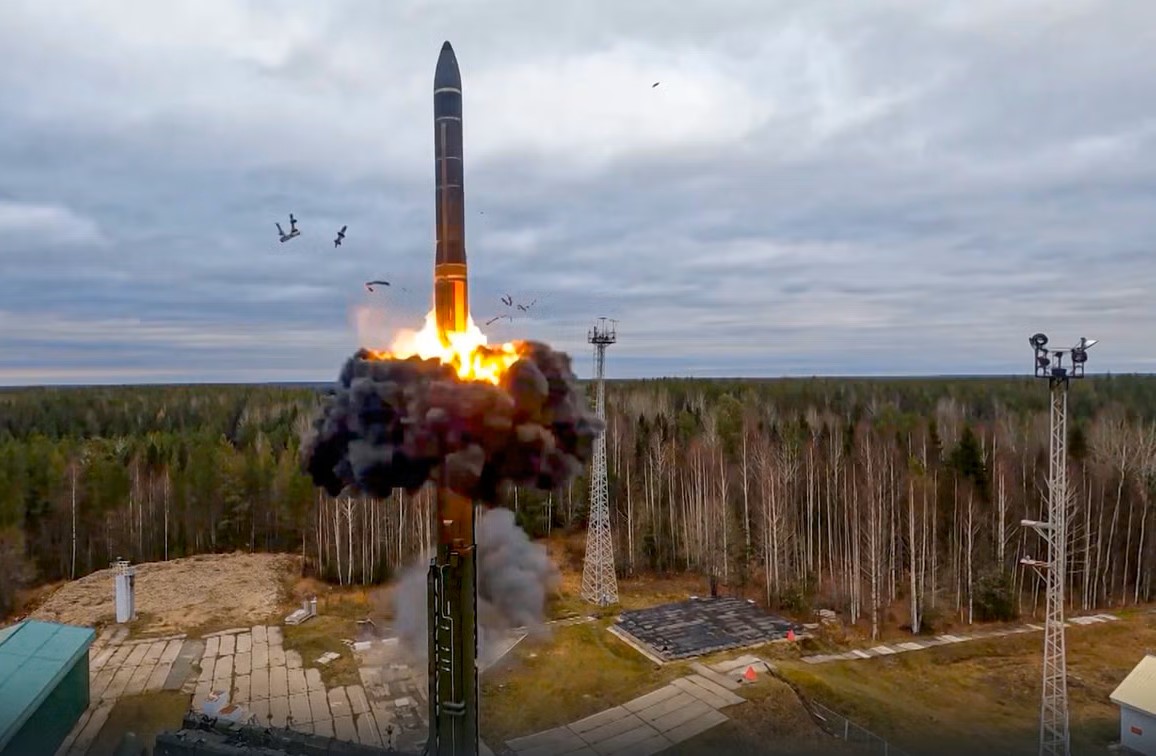
Russia launched another attack on Ukraine using an Oreshnik intermediate-range ballistic missile (IRBM) on the night of 8/9 January 2026, confirming the attack in a statement published on the Russian Ministry of Defence’s (MoD’s) Telegram social media channel.
The Russian MoD stated that on 9 January it had launched “a massive strike using long-range, land- and sea-based precision-guided weapons, including the Oreshnik medium-range ground-mobile missile system”, claiming that the Oreshnik attack was carried out in response to an alleged Ukrainian drone strike on one of the residences of Russian President Vladimir Putin in the Novgorod region, which Ukraine has denied.
Ukrainian President Volodymyr Zelensky and Ukrainian authorities confirmed that a ballistic missile had struck infrastructure in Lviv, about 60 km from the Polish border.
In his daily video address to the nation on 9 January, Zelensky stated, “Oreshnik was used again – this time against the Lviv region. Once again, it was pointedly close to the borders of the European Union. And in terms of using medium-range ballistic missiles, this poses the same challenge for all: Warsaw, Bucharest, Budapest, and many other capitals as well. Everyone needs to see this in the same way and with the same seriousness: if the Russians aren’t even bothering to come up with a plausible excuse for using such weapons, then no personal connections and no rhetoric will protect anyone from this.”
An Oreshnik IRBM was first used by Russian to hit the central city of Dnipro in November 2024.
The Oreshnik system is believed to be derived from Russia’s RS-26 Rubezh IRBM. Nuclear capable and featuring multiple independently targetable re-entry vehicles (MIRVs), the Oreshnik IRBM is believed to have a range of as far as 5,500 km and a terminal velocity of up to Mach 10 (12,300 km/h), making it very difficult to intercept. Putin claimed on 1 August 2025 that the first Oreshniks had been series-produced and entered military service.
How many Oreshnik IRBMs have so far been deployed is unknown, but their occasional use can be seen as Russia flexing its strategic muscles. As well as targeting Ukrainian infrastructure with relative impunity, the system’s use also serves to remind Ukraine’s Western allies that Russia, as a nuclear-armed state, can target most of Europe with such a weapon.





![[via Ugolok_Sitha Telegram Channel]](https://euro-sd.com/wp-content/uploads/2025/11/Russian-Motorbike-loaded_via-Ugolok_Sitha-Telegram-Channel-Kopie-218x150.jpg "Ukraine: Russian forces capture key towns")