


At the DSEI 2025 defence exhibition in London 10 September executives from BAE Systems’ Naval Ships business gave a presentation that offered insights into the company’s work on the designs and concepts of operation for future naval vessels.
As Geoff Searle, future business and technology programme director for BAE Systems Naval Ships, noted in his opening remarks, “The navies of the future will need to be that hybrid mix of platforms and systems, lean crewed and uncrewed, offering greater lethality, mass, agility and availability, and, importantly, the ability to exploit innovation and pace and at the same time offering greater value for money.
“In the future Royal Navy the ship will be at the centre of a broader distributed system of systems, and all capabilities will need to be securely connected and integrated in an assured way, increasing warfighting mass and then increasing the capability against the lethal complex threats in place,” said Searle. In this regard he noted that in late 2024 BAE Systems was awarded the eight-year, GBP 285 million (EUR 329.4 million) Real-time Combat System Open Data Enablers (RECODE) contract, which will both maintain and modernise the combat management systems (CMSs) on the Royal Navy’s surface combatants.
Following this award, said Searle, BAE Systems is putting significant investment into a complete modernisation of its CMS. BAE’s next-generation CMS, known as INTeACT, uses open systems architectures to ensure that state-of-the-art technologies can be adopted quickly to enhance overall ship capability. INTeACT provides warship crews with all the information they need to track, analyse and respond to threats, as well as the ability to co-ordinate resources in other operations such as intelligence gathering and humanitarian assistance, both independently or as part of a multinational coalition.
Searle added that work on the latest INTeACT Version 2 CMS is already well underway and that some new aspects, including a force integration capability, were demonstrated during Exercise ‘Formidable Shield 25’, NATO’s biennial live-fire integrated air and missile defence (IAMD) exercise, which took place in the North Sea in May this year.
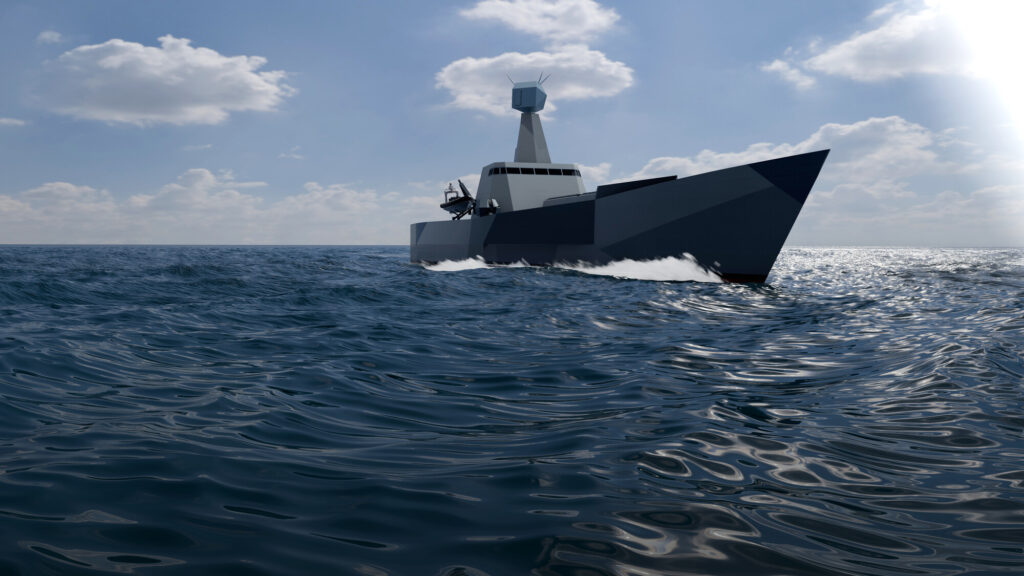
Gavin Rudgley, chief engineer for future business and technology for BAE Systems Naval Ships, told the audience at DSEI 2025, “There’s three challenges that affect us for future naval ships: threats, lifecycle and crewing. The traditional naval threats just remain as they are, so they will always be there, but we are now seeing the emergence of high-end threats. By high end it means high speed, high mobility, high altitude, high mass. Those two things lead to a future combat space where we have a layered defence so we have the right effector for the appropriate threat, and we have a system-of-systems approach, with command ships operating in conjunction with smaller deployed picket ships, or ‘wingmen’.
“The next challenge, then, is the life cycle: the duration of designing and building naval ships is now much longer than for the technology that gets deployed on them.”
Rudgley explained that this needed to be accounted for in two ways: creating adaptability in the ship’s design, both in build and in service; and actually accelerating the time it takes to design a ship. In terms of adaptability, future ships need to have reconfigurable power and propulsion systems, with sufficient margins built in, and be built using open systems architectures for the platform management system, combat management system and navigation/bridge systems. Regarding speeding up ship designing, Rudgley noted that BAE Systems’ use of artificial intelligence to optimise ship design means that, whereas 10 to 15 years ago the company would be developing around six different hull forms before putting the ship into build, now it can develop 300 to 400 hull forms in a matter of hours.
“And the third challenge, then, is around crewing,” Rudgley continued. “So there is a drive across many navies to reduce the complement on ships. That’s going to come about through the automation, autonomy and the artificial intelligence within some of those systems, but also through a cultural change in the way that ships are operated. For that to be successful we need to work with our customers to develop what that concept of operations will be for future naval ships, what sort of people, what training, what skill levels, and what the technology is that gets fitted and supported in service.”
As an example of how the three challenges he presented are being addressed, Rudgley then presented a future concept for naval anti-air warfare operations. Given that the Royal Navy’s future class of Type 26 frigates, which are currently in build, are focused on anti-submarine warfare, naval air defence platforms will inevitably be the next area of focus.
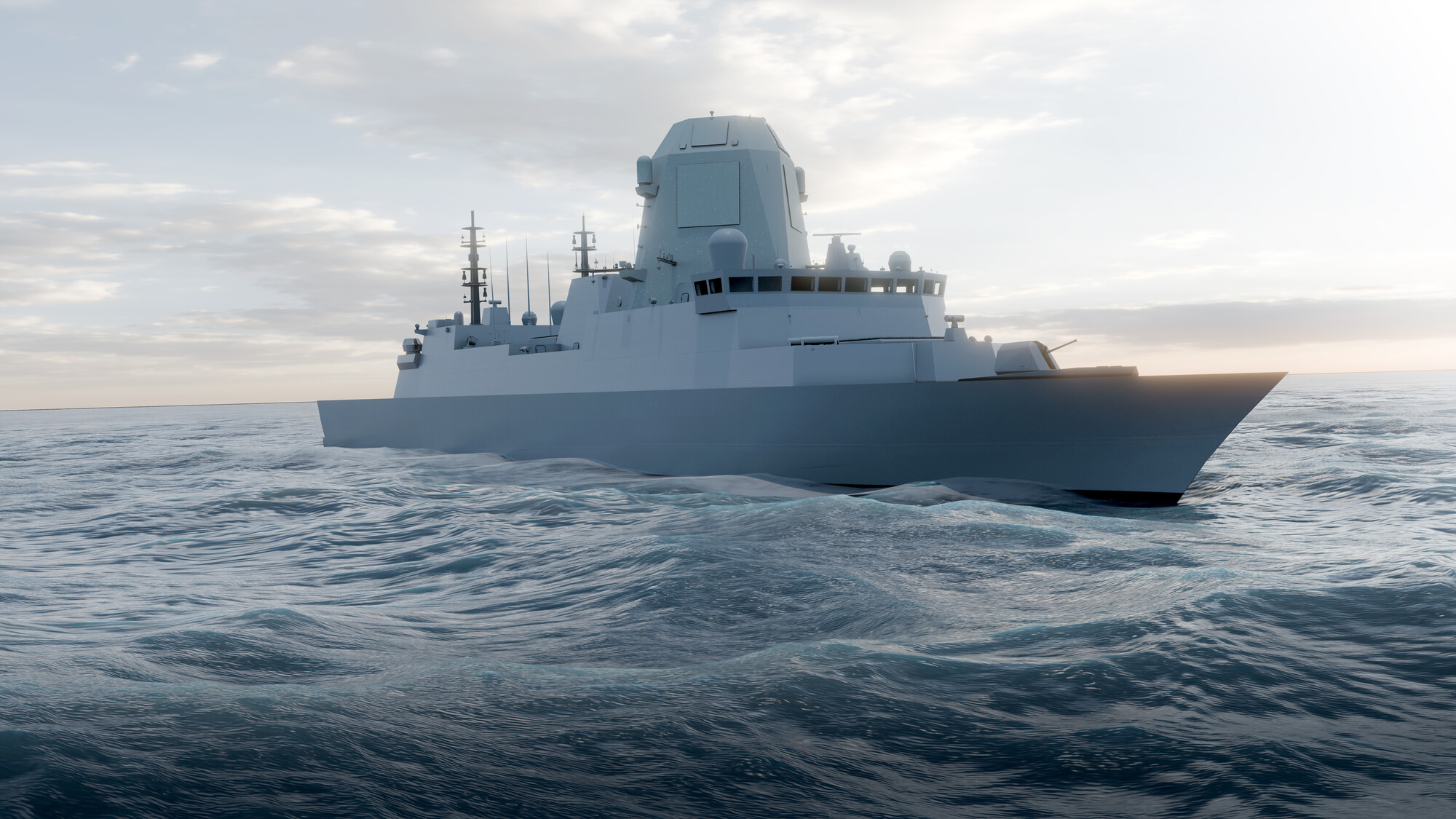
Rudgley thus presented a CGI of a future air warfare command ship, which would be the central platform in a system-of-systems approach for anti-air warfare and would host the main command function, the main sensor and a selection of effectors, including missiles, guns and directed-energy weapons.
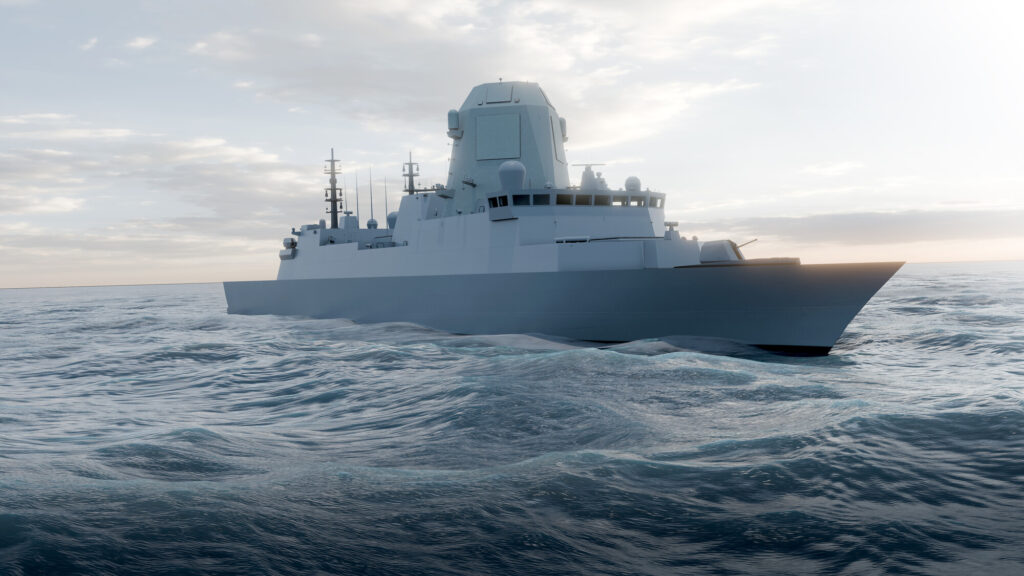
Rudgley noted that BAE had selected a trimaran hull for this vessel, based on the success achieved with the prototype UK warship demonstrator vessel RV Triton, which following its launch in 2000 was used to conduct two years of risk reduction trials for the UK Ministry of Defence. The seakeeping behaviours of a trimaran are equivalent to a much larger monohull vessel, while it also has speed benefits, achieving highers speeds with less power, Rudgley added.